JEE Main Physics Question Paper with Solution 2023 January 29th Shift 1 - Morning
A
$1: 3$
B
$3: 1$
C
$1: 1$
D
$1: 27$
Solution
$ H =\frac{ V ^2}{ R } \times t$
$ \frac{ H _1}{ H _2}=\frac{\frac{ V ^2 t }{ R }}{\frac{ V ^2 t }{3 R }}=3: 1$
A
$\sqrt{\frac{G m}{r}}$
B
$\sqrt{\frac{G m}{4 r}}$
C
$\sqrt{\frac{4 G m}{r}}$
D
$\sqrt{\frac{G m}{2 r}}$

A
$\frac{2 \sqrt{3}+1}{2}$
B
$\frac{2 \sqrt{3}-1}{2}$
C
$\frac{\sqrt{3}}{2}$
D
$\frac{1}{2 \sqrt{3}}$
Solution
$Mg \sin 30^{\circ}-\mu mg \cos 30^{\circ}= ma$
$\frac{g}{2}-\frac{\sqrt{3}}{2} \cdot \mu g=\frac{g}{4}$

A
$4: 1$
B
$1: 2$
C
$4: 3$
D
$1: 4$
Solution
$\frac{ KE _{ POP }}{ KE _{\text {top }}}=\frac{\frac{1}{2} M ( u )^2}{\frac{1}{2} M \left( u \cos 30^{\circ}\right)^2}=\frac{4}{3}$
A
$\frac{1}{8}$
B
$\frac{1}{2}$
C
$\frac{1}{4}$
D
$\frac{1}{16}$
Solution
$\frac{ N }{ N _0}=\left(\frac{1}{2}\right)^{ t /t \frac{1}{2}}=\left(\frac{1}{2}\right)^{\frac{90}{30}}$
$\frac{ N }{ N _0}=\left(\frac{1}{2}\right)^3=\frac{1}{8}$
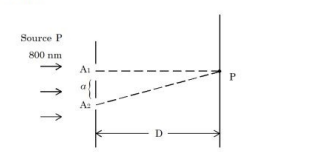
A
$0.4 \,mm$
B
$0.2\, mm$
C
$0.5\, mm$
D
$0.1\, mm$
Solution
$ A _2 P - A _1 P =\frac{\lambda}{2} $ (Condition of minima)
$ \sqrt{ D ^2+ a ^2}- D =\frac{\lambda}{2} $
$ D \left(1+\frac{ a ^2}{ D ^2}\right)^{1 / 2}- D =\frac{\lambda}{2} $
$ D \left(1+\frac{1}{2} \times \frac{ a ^2}{ D ^2}\right)- D =\frac{\lambda}{2} $
$\frac{ a ^2}{2 D }=\frac{\lambda}{2} \Rightarrow a =\sqrt{\lambda \cdot D } $
$ =\sqrt{800 \times 10^{-6} \times 50} $
$ a =0.2\, mm$
A
Both $A$ and $R$ are correct but $R$ is not the correct explanation of $A$
B
A is correct but $R$ is not correct
C
A is not correct but $R$ is correct
D
Both $A$ and $R$ are correct and $R$ is the correct explanation of $A$
Solution
First law of thermodynamics is based on law of conservation of energy and it can be written as $dQ = dU - dW$.
where $dW$ is work done on the system
A
B and D only
B
C and D only
C
A and Conly
D
B and C only
Solution
Speed of light does not depend on the motion of source as well as intensity.
A
$36\, km$
B
$32\, km$
C
$28\, km$
D
$64 \, km$
Solution
Maximum line of sight distance between two antennas, $d _{ M }=\sqrt{2 Rh _{ T }}+\sqrt{2 R \cdot h _{ R }}$
$d _{ M }=2 \times \sqrt{2 \times 6.4 \times 10^6 \times 80}=64 \,km$
A
$\frac{q}{12 \epsilon_0}$
B
$\frac{q}{2 \epsilon_0}$
C
$\frac{q}{3 \epsilon_0}$
D
$\frac{q}{6 \in_0}$
Solution

Flux passing through shaded face $=\frac{ q }{6 \varepsilon_0}$
A
B
B
C
C
A
D
C and D
Solution
LED works in forward biasing and light energy maybe slightly less or equal to band gap.

A
0
B
$\frac{\mu_0 I}{\pi a}$
C
$\frac{\mu_0 I}{2 \pi a}$
D
$\frac{\mu_0 I}{4 \pi a}$
Solution
Magnetic field due to current in BC and ET are outward at point ' $O$ '
$B _0=\frac{\mu_0 i }{4 \pi r }+\frac{\mu_0 i }{4 \pi r }=\frac{\mu_0 i }{2 \pi r }=\frac{\mu_0 i }{\pi a }$
A
$33 \,Hz$
B
$80 \, Hz$
C
$10 \, Hz$
D
$55 \, Hz$
Solution
$ f _1=300\left(\frac{330-0}{330-(-30)}\right)=275$
$ f _2=300\left(\frac{330-0}{330-(30)}\right)=330$
$ \Delta f =330-275=55\, Hz $
A
$9.24 \times 10^{-4} J$
B
$18.48 \times 10^{-4} J$
C
$0.72 \times 10^{-4} J$
D
$5.76 \times 10^{-4} J$
Solution
Surface area of soap bubble $=2 \times 4 \pi R ^2$
Work done $=$ change in surface energy $\times T _{ S }$
$= T _{ S } \times 8 \pi \times\left( R _2^2- R _1^2\right) $
$=2 \times 10^{-2} \times 8 \times \frac{22}{7} \times 49 \times \frac{3}{4} \times 10^{-4} $
$=18.48 \times 10^{-4} J$
A
B
C
D
Solution
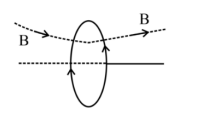
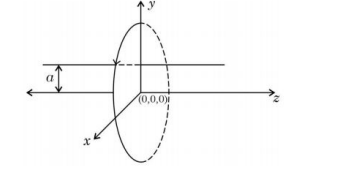
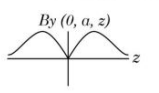
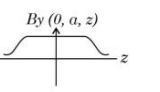
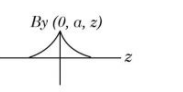
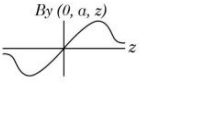
$B _{ y }=0$ in plane of coil
$B_y$ is opposite of each other in $- z$ and $+ z$ positions.
A
$3.4\, ms ^{-1}$
B
$13\, ms ^{-1}$
C
$17\, ms ^{-1}$
D
$22.4\, ms ^{-1}$
Solution
$f _{ s }=\frac{ mv^{2 } }{ r }$
For maximum speed in safe turning,
$ f _{ s }= f _{ s } \max =\mu mg $
$ v _{\max } \text { (for safe turning }=\sqrt{\mu rg } $
$=\sqrt{0.34 \times 50 \times 10} \approx 13\, m / s$

A
$M=\frac{2 \sqrt{2} \mu_0 R^2}{L}$
B
$M=\frac{\sqrt{2} \mu_0 R^2}{L}$
C
$M=\frac{2 \sqrt{2} \mu_0 R}{L^2}$
D
$M=\frac{\sqrt{2} \mu_0 R}{L^2}$
Solution
$ \phi= Mi $
$ \phi=( BA )$
$ \phi=\pi R ^2\left(4 \frac{\mu_0}{4 \pi} \frac{ i }{\left(\frac{ L }{2}\right)} \sqrt{2}\right)$
$ \Rightarrow M =\frac{2 \sqrt{2} \mu_0 R ^2}{ L }$
A
C only
B
B and Conly
C
C and D only
D
A and D only
Solution
$ \lambda < 5500 \mathring A $ for photoelectric emission
$\lambda_{ uv } < 5500 \mathring A$
A
A-II, B-III, C-I, D-IV
B
A-III, B-II, C-IV, D-I
C
A-II, B-III, C-IV, D-I
D
A-III, B-II, C-I, D-IV
Solution
Pressure gradient $=\frac{ dp }{ dx }=\frac{\left[ ML ^{-1} T ^{-2}\right]}{[ L ]} $
$ =\left[ M ^1 L ^{-2} T ^{-2}\right] $
Energy density $=\frac{\text { energy }}{\text { volume }}=\frac{\left[ ML ^2 T ^{-2}\right]}{\left[ L ^3\right]} $
$ =\left[ M ^1 L ^{-1} T ^{-2}\right] $
Electric field $=\frac{\text { Force }}{\text { ch arge }}=\frac{\left[ MLT ^{-2}\right]}{[\text { A.T }]} $
$ =\left[ M ^1 L ^1 T ^{-3} A ^{-1}\right] $
Latent heat $=\frac{\text { heat }}{\text { mass }}=\frac{\left[ ML ^2 T ^{-2}\right]}{[ M ]} $
$ =\left[ M ^0 L ^2 T ^{-2}\right] $
A
$262\, kPa$
B
$270 \,kPa$
C
$360\, kPa$
D
$278\, kPa$
Solution
Taking volume constant: $\frac{P_1}{T_1}=\frac{P_2}{T_2}$
$ \Rightarrow P _2=\frac{ P _1}{ T _1} \times T _2=\frac{270 \times(309)}{300} $
$ =278\, kPa$
Answer: 28
Solution
By average form of Newton's law of cooling
$ \frac{20}{6}=k(50-10) .....$(i)
$ \frac{40- T }{6}= K \left(\frac{40+ T }{2}-10\right)....$(ii)
From equation (i) and (ii)
$\frac{20}{40- T }=\frac{40}{10+ T / 2} $
$10+\frac{ T }{2}=80-2 T$
$ \frac{5 T }{2}=70 \Rightarrow T =28^{\circ} C$
Answer: 120
Solution
$v _{ i }=\sqrt{2 gh _{ i }} $
$ =\sqrt{2 \times 10 \times 9.8} \downarrow $
$ =14\, m / s \downarrow$
$ v _{ f }=\sqrt{2 gh _{ f }} $
$ =\sqrt{2 \times 10 \times 5} \uparrow$
$ = 1 0 \,m / s \uparrow$
$\left|\vec{ a }_{ avg }\right|=\left|\frac{\Delta \vec{ v }}{\Delta t }\right|=\frac{24}{0.2}=120 \,m / s ^2$
Answer: 300
Solution
Displacement is $8^{\text {th }}$ sec.
$ S _8=0+\frac{1}{2} \times 10 \times(2 \times 8-1)$
$ S _8=5 \times 15$
$ \Delta U =0.4 \times 10 \times 5 \times 15$
$ \Delta U =20 \times 15=300$
Answer: 10
Solution
$ \text { EMF }=\frac{ d }{ dt }\left( B \pi r ^2\right) $
$ =2 B \pi r \frac{ dr }{ dt }=2 \times \pi \times 0.1 \times 0.8 \times 2 \times 10^{-2}$
$ =2 \pi \times 1.6= 1 0 . 0 6 \text { [round off } 1 0 . 0 6 = 1 0 \text { ] }$

Answer: 24
Solution
By first polaroid $P_1$ intensity will be halved then $P_2$ and $P_3$ will make intensity $\cos ^2\left(60^{\circ}\right)$ and $\cos ^2\left(30^{\circ}\right)$ times respectively.
Intensity out $=\frac{256}{2} \times \frac{1}{4} \times\left(\frac{\sqrt{3}}{2}\right)^2=\frac{256 \times 3}{2 \times 4 \times 4}= 2 4$
Answer: 24
Solution
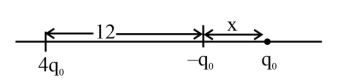
$\frac{q_0}{x^2}=\frac{4 q_0}{(x+12)^2} $
$ x+12=2 x$
$ x=12$
Distance from origin $=x+12=24\, cm$.
Answer: 40
Solution
$ KE =\frac{1}{2} mv ^2+\frac{1}{2} I \omega^2 $
$ 2240=\frac{1}{2} 2( v )^2+\frac{1}{2} \frac{2}{5}(2) R ^2 \cdot\left(\frac{ v }{ R }\right)^2 $
$2240= v ^2+\frac{2}{5} v ^2$
$ \Rightarrow v =40 \,m / s $
Answer: 2
Solution
$ \frac{2}{\left(\frac{3 x}{3+x}\right)}=\frac{40+22.5}{60-22.5}=\frac{62.5}{37.5}=\frac{5}{3} $
$ \frac{6}{5}=\frac{3 x}{3+x} $
$ 6+2 x=5 x \Rightarrow x=2$
Answer: 120
Solution
$ 2 A \cos \left(\frac{\Delta \phi}{2}\right)= A$
$ \cos \left(\frac{\Delta \phi}{2}\right)=\frac{1}{2} $
$ \frac{\Delta \phi}{2}=60^{\circ}$
Answer: 87
Solution
$ P=92-2-2+1-1-1 $
$ P=92-5 $
$ P = 8 7$
JEE Main Chemistry Question Paper with Solution 2023 January 29th Shift 1 - Morning
A
(A), (E), (B), (D), (C)
B
(C), (E), (D), (B), (A)
C
(C), (D), (E), (B), (A)
D
(A), (B), (E), (D), (C)
Solution
Order of acidity for following phenol is
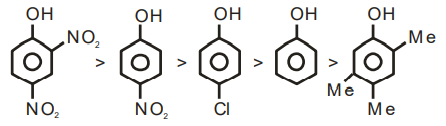
- $M$ and $- I$ increases acidity
$+ M$ and $+ I$ decreases acidity
A
$Cu_3B_2$
B
$Cu \left( BO _2\right)_2$
C
$Cu$
D
$CuO$
Solution
Blue green colour is due to formation of $Cu \left( BO _2\right)_2$
$ CuSO _4 \xrightarrow{\Delta} CuO + SO _3 $
$CuO + B _2 O _3 \rightarrow Cu \left( BO _2\right)_2$
A
$Ni +4 CO \stackrel{\Delta}{\longrightarrow} Ni ( CO )_4$
B
$2 K \left[ Au ( CN )_2\right]+ Zn \stackrel{\Delta}{\longrightarrow} K _2\left[ Zn ( CN )_4\right]+2 Au$
C
$Zr +2 I _2 \stackrel{\Delta}{\longrightarrow} Zr I _4$
D
$ZnO + C \stackrel{\Delta}{\longrightarrow} Zn + CO$
Solution
Mond's process uses:
$Ni +4 CO \rightarrow\left[ Ni ( CO )_4\right]$
A
(A) - III, (B) - I, (C) - II, (D) - IV
B
(A) - II, (B) - I, (C) - IV, (D) - III
C
(A) - III, (B) - I, (C) - IV, (D) - II
D
(A) - I, (B) - II, (C) - IV, (D) - III
Solution
(A) Narrow spectrum antibiotic - penicillin-G
(B) Antiseptic - Furacine
(C) Disinfectants - sulphur dioxide
(D) Broad spectrum antisiotics - chloramphenicol
A
$F_2$
B
$Cl_2$
C
$I_2$
D
$Br_2$
Solution
Bond energy of $F _2$ less than $Cl _2$ due to lone pair lone pair repulsions. Bond energy order $Cl _2> Br _2> F _2> I _2$
A
Both $NO _2$ and $SO _2$ are present in classical smog
B
Classical smog also has high concentration of oxidizing agents
C
$NO _2$ is present in classical smog
D
Photochemical smog has high concentration of oxidizing agents
Solution
Photochemical smog has high concentration of oxidising agents
$NO _2$ is produced from $NO$ and $O _3$ in the presence of sunlight
Classical smog contain smoke, fog and $SO _2$ and it is known as reducing smog, as chemically it is reducing mixture
 Choose the correct answer from the option given below:
A
(B), (C) and (D) only
B
( A ),( C ) and (E) only
C
(A), (C) and (D) only
D
(A), (B) and (E) only
Solution
Boiling point of alkyl halide increases with increase in size, mass of halogen atom and size of alkyl group
Boiling point of isomeric alkyl halide decreases with increase in branching
Density increases with increase in atomic mass of halogen atom

A
$1-\frac{b}{v}$
B
$1-\frac{a}{R T V}$
C
$1+\frac{b}{V}$
D
$1+\frac{a}{R T V}$
Solution
For 1 mole of real gas
$PV = ZRT$
from graph PV for real gas is less than PV for ideal gas at point $A$
$ Z < 1 $
$Z=1-\frac{a}{ V _{ m } RT }$
A
$Li / P _4$
B
Di-isobutylaluminium hydride
C
$SiH _4$
D
$NaNi _5$
A
diamagnetic, paramagnetic and diamagnetic
B
diamagnetic, diamagnetic and paramagnetic
C
paramagnetic, paramagnetic and diamagnetic
D
paramagnetic, diamagnetic and paramagnetic
Solution
$Li _2 O \rightarrow O ^{2-} \rightarrow$ diamagnetic
$Na _2 O _2 \rightarrow O _2{ }^{2-} \rightarrow$ diamagnetic
$KO _2 \rightarrow O _2^{-} \rightarrow$ paramagnetic


A
$\operatorname{cis}-\left[ PtCl _2\left( NH _3\right)_2\right]$
B
trans $-[ PtCl 2( en ) 2]^{2+}$
C
trans - $\left[ Co \left( NH _3\right)_4 Cl _2\right]^{+}$
D
$cis -\left[ PtCl _2( en )_2\right]^{2+}$

A
$C > E > A > B > D$
B
$C > E > A > D > B$
C
$C > A > E > B > D$
D
$E > C > A > B > D$
Solution
Hydration enthalpies:
(i) $K ^{\prime}> Rb ^{\prime}> Cs ^{\prime}$ : (A) $>$ (B) $>$ (D)
(ii) $Mg ^{+2}> Ca ^{+2} : (C) > (E) $
Option (D)
$( C )>( E )>( A )>( B )>( D )$
A
(A)−II,(B)−IV,(C)−I,(D)−I
B
(A) −III,(B)−IV,(C)−I,(D)−II
C
(A)−II,(B)−IV,(C)−I,(D)−III
D
(A) −II,(B)−I,(C)−III,(D)−IV
Solution
Reactions
Reagent used
A
Hoffmann Degradation
$Br_2 , NaOH$
B
Clemenson reduction
$Zn - Hg / HCl$
C
Cannizaro reaction
Conc.KOH, $\Delta$
D
Reimer-Tiemann Reaction
$CHCl _3, NaOH / H _3 O ^+$
| Reactions | Reagent used | |
|---|---|---|
| A | Hoffmann Degradation | $Br_2 , NaOH$ |
| B | Clemenson reduction | $Zn - Hg / HCl$ |
| C | Cannizaro reaction | Conc.KOH, $\Delta$ |
| D | Reimer-Tiemann Reaction | $CHCl _3, NaOH / H _3 O ^+$ |
A
$NO , NO _2$
B
$NO _2, N _2 O _4$
C
$N _2 O _3, NO _2$
D
$NO _2, N _2 O _5$
Solution
$4 NH _3+5 O _2 \xrightarrow{\Delta} \underset{(A)}{4 NO} +6 H _2 O$
$2 NO + O _2 \longrightarrow \underset{(B)}{2 NO _2}$
A
$\frac{9 \lambda}{5}$
B
$\frac{36 \lambda}{5}$
C
$\frac{5 \lambda}{9}$
D
$\frac{5}{9 \lambda}$
Solution
For $H : \frac{1}{\lambda}= R _{ H } \times 1^2\left(\frac{1}{1^2}-\frac{1}{\infty^2}\right) .....$(1)
$\frac{1}{\lambda_{ He ^{+}}}= R _{ H } \times 2^2 \times\left(\frac{1}{4}-\frac{1}{9}\right).....$(2)
From (1) & (2) $\frac{\lambda_{ He ^{+}}}{\lambda}=\frac{9}{5}$
$ \lambda_{ He ^{+}}=\lambda \times \frac{9}{5}$
$ \lambda_{ He ^{+}}-\frac{9 \lambda}{5}$
A
$NH _2 OH . HCl$
B
$CH _3 NH _2 \cdot HCl$
C
$NH _4 Cl$
D
$N _2 H _4 \cdot HCl$
Solution
$CH _3 NH _2 . HCl \xrightarrow[\text { fusion }]{ Na } NaCN$ and $NaCl$
$NaCN$ gives $+ ve$ test for nitrogen and
$NaCl$ gives +ve test for halogen
A
$V ^{2+}$ and $Mn ^{2+}$
B
$Mn ^{2+}$ and $Co ^{2+}$
C
$Cr ^{2+}$ and $Co ^{2+}$
D
$V ^{2+}$ and $Cr ^{2+}$
Solution
Metal cation with $(-)$ value of reduction potential $\left( M ^{+3} / M ^{+2}\right)$ or with $(+)$ value of oxidation potential $\left( M ^{+2} / M ^{+3}\right)$ will liberate $H _2$
Therefore they will reduce $H ^{+}$
i.eV ${ }^{+2}$ and $Cr ^{+2}$
A
$10\, mL$ of $0.1 \,mol\, dm ^{-3} Ca _3\left( PO _4\right)_2$
B
$10\, mL$ of $0.2 \,mol \,dm ^{-3} AlCl _3$
C
$10 \,mL$ of $0.15\, mol \,dm ^{-3} CaCl _2$
D
$10 \,mL$ of $0.1 \,mol \,dm ^{-3} Na _2 SO _4$
Solution
Formed is negatively charged solution, therefore $Al ^{3+}$ has highest coagulating power


Answer: 3
Solution
$ICl _4^{-}, BrF _3$ and $NO _2^{+}$do not have odd number of $e ^{-}$

Answer: 3
Solution
Moles of hydrocarbon $=\frac{17 \times 10^{-3}}{136}=1.25 \times 10^{-4}$
Mole of $H _2$ gas
$\Rightarrow 1 \times \frac{8.40}{1000}= n \times 0.0821 \times 273$
$ \Rightarrow n =3.75 \times 10^{-4}$
Hydrogen molecule used for 1 molecule of hydrocarbon is 3
$=\frac{3.75 \times 10^{-4}}{1.25 \times 10^{-4}}=3$
Answer: 2
Solution

$ P _0\left[1+\frac{\alpha}{2}\right]=1 $...(i)
$ K _{ p }=\frac{\left( P _{ H _2}\right)\left( P _{ O _2}\right)^{1 / 2}}{ P _{ H _2 O }}$
$ \frac{\left( P _0 \alpha\right)\left(\frac{ P _0 \alpha}{2}\right)^{1 / 2}}{ P _0[1-\alpha]}=2 \times 10^{-3} $
since $ \alpha $ is negligible w.r.t $ 1 \text { so } P _0=1 \text { and } 1-\alpha \approx 1 $
$ \frac{\alpha \sqrt{\alpha}}{\sqrt{2}}=2 \times 10^{-3} $
$ \alpha^{3 / 2}=2^{3 / 2} \times 10^{-3} $
$ \alpha=2^{3 / 2 \times 2 / 3} \times 10^{-3 \times 2 / 3}$
$ \alpha=2 \times 10^{-2} \% \alpha=2 \%$

Answer: 6
Solution
$ R _{ f }=\frac{\text { Distance moved by the substance from base line }}{\text { Distance moved by the solvent from base line }} $
$ =\frac{3.0\, cm }{5.0 \, cm }=0.6 \text { or } 6 \times 10^{-1}$
Answer: 13
Solution

In final solution
$\Delta T _{ f }=0.8=1.8\left[\frac{0.3-3 x +0.2+0.2}{1}\right] $
$\Rightarrow x =\frac{2.3}{27}$
$ \Rightarrow K _{ sp }=\left(0.1-\frac{2.3}{27}\right)\left(0.2-\frac{4.6}{27}\right)^2=13 \times 10^{-6}$

Answer: 2
Solution
Only option (B) is correct as order cannot be determined
Answer: 6
Solution
$ \because \Delta G ^{ o }=- RT \ln K _{ eq } $
$ \text { and } K _{ eq }=\frac{ K _{ f }}{ K _{ b }} $
$ \therefore K _{ eq }=\frac{10^3}{10^2}=10$
$ \therefore \Delta G =- RT \ln 10 $
$\Rightarrow-(8.3 \times 300 \times 2.3)=-5.7 \,kJ \,mole ^{-1} \approx 6 kJ$
$ \text { mole }^{-1}(\text { nearest integer }) $
$ \text { Ans }=6$
Answer: 5
Solution
$ \because pH =12 $
$ \therefore\left[ H ^{+}\right]=10^{-12} M$
$ \therefore[ OH ]=10^{-2} M $
$ \therefore\left[ Ca ( OH )_2\right]=5 \times 10^{-3} M $
$5 \times 10^{-3}=\frac{\text { milli moles of } Ca ( OH )_2}{100 mL } $
$\text { milli moles of } Ca ( OH )_2=5 \times 10^{-1}$
$ \text { Ans. }=5$
JEE Main Mathematics Question Paper with Solution 2023 January 29th Shift 1 - Morning
A
$2 \sqrt{13}$
B
$\frac{2 \sqrt{13}}{3}$
C
$\sqrt{13}$
D
$\frac{3 \sqrt{3}}{4}$
Solution
Equation of tangent at $A (4, -11)$ on circle is
$ \Rightarrow 4 x-11 y-3\left(\frac{x+4}{2}\right)+10\left(\frac{y-11}{2}\right)-15=0$
$\Rightarrow 5 x-12 y-152=0 \ldots \ldots(1)$
Equation of tangent at B $(8,-5)$ on circle is
$ \Rightarrow 8 x-5 y-3\left(\frac{x+8}{2}\right)+10\left(\frac{y-5}{2}\right)-15=0 $
$\Rightarrow 13 x-104=0 \Rightarrow x=8$
put in (1) $\Rightarrow y =\frac{28}{3}$
$r =\left|\frac{3.8+\frac{2.28}{3}-34}{\sqrt{13}}\right|=\frac{2 \sqrt{13}}{3}$
A
250
B
20
C
25
D
30
Solution
$X$
$P(X)$
$XP(X)$
$X^2P(X)$
0
1/6
0
0
1
1/2
1/2
1/2
2
3/10
6/10
12/10
4
1/30
1/10
9/30
$ \sum xP ( x )=\frac{6}{2}=\mu $
$ \sigma^2=\sum x ^2 P ( x )-\mu^2 $
$ \sigma^2+\mu^2=0+\frac{1}{2}+\frac{12}{10}+\frac{9}{30}=2$
$ 10\left(\sigma^2+\mu^2\right)=20 \text { Ans. }$
| $X$ | $P(X)$ | $XP(X)$ | $X^2P(X)$ |
|---|---|---|---|
| 0 | 1/6 | 0 | 0 |
| 1 | 1/2 | 1/2 | 1/2 |
| 2 | 3/10 | 6/10 | 12/10 |
| 4 | 1/30 | 1/10 | 9/30 |
A
$\frac{\pi}{\pi+1}$
B
$\frac{\pi-1}{\pi+1}$
C
$\frac{\pi+1}{\pi-1}$
D
$\frac{\pi}{\pi-1}$
Solution
$y^2+(x-1)^2=4$

shaded portion $=\text { circular }( OABC )$
$ -\operatorname{Ar}(\triangle OAB ) $
$=\frac{\pi(4)}{4}-\frac{1}{2}(2)(1)$
$ A =(\pi-1)$

Area $B =\operatorname{Ar}(\triangle AOB )+$ Area of arc of circle $( ABC )$
$ =\frac{1}{2}(1)(2)+\frac{\pi(2)^2}{4}=\pi+1 $
$ \frac{ A }{ B }=\frac{\pi-1}{\pi+1}$
A
$7 x^2+245 x-250=0$
B
$49 x^2+245 x+250=0$
C
$49 x^2-245 x+250=0$
D
$7 x^2-245 x+250=0$
Solution
$ 14 x^2-31 x+3 \lambda=0$
$ \alpha+\beta=\frac{31}{14} \ldots . .(1) $
and $ \alpha \beta=\frac{3 \lambda}{14} \ldots .(2) $
$ 35 x^2-53 x+4 \lambda=0$
$ \alpha+\gamma=\frac{53}{35} \ldots .(3) $
and $ \alpha \gamma=\frac{4 \lambda}{35} \ldots .(4) $
$ \frac{(2)}{(4)} \Rightarrow \frac{\beta}{\gamma}=\frac{3 \times 35}{4 \times 14}=\frac{15}{8} \Rightarrow \beta=\frac{15}{8} \gamma$
$(1)-(3) \Rightarrow \beta-\gamma=\frac{31}{14}-\frac{53}{35}=\frac{155-106}{70}=\frac{7}{10}$
$ \frac{15}{8} \gamma-\gamma=\frac{7}{10} \Rightarrow \gamma=\frac{4}{5} $
$\Rightarrow \beta=\frac{15}{8} \times \frac{4}{5}=\frac{3}{2} $
$ \Rightarrow \alpha=\frac{31}{14}-\beta=\frac{31}{14}-\frac{3}{2}=\frac{5}{7} $
$ \Rightarrow \lambda=\frac{14}{3} \alpha \beta=\frac{14}{3} \times \frac{5}{7} \times \frac{3}{2}=5$
so, sum of roots $\frac{3 \alpha}{\beta}+\frac{4 \alpha}{\gamma}=\left(\frac{3 \alpha \gamma+4 \alpha \beta}{\beta \gamma}\right)$
$=\frac{\left(3 \times \frac{4 \lambda}{35}+4 \times \frac{3 \lambda}{14}\right)}{\beta \gamma}=\frac{12 \lambda(14+35)}{14 \times 35 \beta \gamma}$
$=\frac{49 \times 12 \times 5}{490 \times \frac{3}{2} \times \frac{4}{5}}=5$
Product of roots
$=\frac{3 \alpha}{\beta} \times \frac{4 \alpha}{\gamma}=\frac{12 \alpha^2}{\beta \gamma}=\frac{12 \times \frac{25}{49}}{\frac{3}{2} \times \frac{4}{5}}=\frac{250}{49}$
So, required equation is $x^2-5 x+\frac{250}{49}=0$
$\Rightarrow 49 x^2-245 x+250=0$
A
$\frac{1}{e^2}$
B
$\frac{1}{e}$
C
0
D
$e^2$
Solution
$ \frac{x+1}{x^2} d x=\frac{d y}{y} $
$ \ln x-\frac{1}{x}=\ln y+c$
$ (1, e ) $
$ c =-2 $
$ \ln x-\frac{1}{x}=\ln y-2 $
$ y=e^{\ln x}-\frac{1}{x}+2 $
$ \displaystyle\lim _{x \rightarrow 0^{+}} e^{\ln x-1}-\frac{1}{x}+2$
$ =e^{-\infty} $
$ =0$
A
$\frac{5+4 \sqrt{2}}{3}$
B
$\frac{8+4 \sqrt{2}}{3}$
C
$\frac{1+5 \sqrt{2}}{3}$
D
$\frac{4+5 \sqrt{2}}{3}$
Solution

$ A=\int\limits_0^1 1 \cdot d x+\int\limits_1^{\sqrt{2}} 2 d x+\int\limits_{\sqrt{2}}^2 x^2 d x $
$ =1+2 \sqrt{2}-2+\frac{8}{3}-\frac{2 \sqrt{2}}{3} $
$ =\frac{5}{3}+\frac{4 \sqrt{2}}{3}$
A
$\sqrt{3}-\frac{2}{3}$
B
$2 \sqrt{3}-\frac{2}{3}$
C
$2 \sqrt{3}-\frac{1}{3}$
D
$\sqrt{3}-\frac{4}{3}$
Solution

Area $2 \int\limits_1^3 2 \sqrt{x} d x+2 \int\limits_3^{\sqrt{21}} \sqrt{21-x^2 d x}$
$ \Delta=\frac{8}{3}(3 \sqrt{3}-1)+21 \sin ^{-1}\left(\frac{2}{\sqrt{7}}\right)-6 \sqrt{3} $
$ \frac{1}{2}\left(\Delta-21 \sin ^{-1}\left(\frac{2}{\sqrt{7}}\right)\right)=\frac{2 \sqrt{3}-\frac{8}{3}}{2} $
$ =\sqrt{3}-\frac{4}{3}$
A
2
B
1
C
$-1$
D
0
Solution
$\displaystyle \lim _{x \rightarrow p ^{+}}\left(\frac{1-\cos \left(x^2-4 p x+q^2+8 q+16\right)}{\left(x^2-4 p x+q^2+8 q+16\right)^2}\right)\left(\frac{\left(x^2-4 p x+q^2+8 q+16\right)^2}{(x-2 p)^2}\right) $
$\displaystyle\lim _{h \rightarrow 0} \frac{1}{2}\left(\frac{(2 p+h)^2-4 p(2 p+h)+q^2+82+16}{h^2}\right)^2=\frac{1}{2}$
Using L'Hospital's
$\displaystyle\lim _{x \rightarrow 2 p^{+}}[f(x)]=0$
A
$\frac{2}{(\sqrt{3}-1)}$
B
$\frac{\sqrt{3}}{2(\sqrt{3}+1)}$
C
$\frac{2}{3+\sqrt{3}}$
D
$\frac{2}{3-\sqrt{3}}$
Solution
Slope of reflected ray $=\tan 60^{\circ}=\sqrt{3}$
Line $y=\frac{x}{\sqrt{3}}$ intersect $y+x=1$ at $\left(\frac{\sqrt{3}}{\sqrt{3}+1}, \frac{1}{\sqrt{3}+1}\right)$
Equation of reflected ray is
$y-\frac{1}{\sqrt{3}+1}=\sqrt{3}\left(x-\frac{\sqrt{3}}{\sqrt{3}+1}\right)$
Put $y =0 \Rightarrow x =\frac{2}{3+\sqrt{3}}$
A
$2 \sqrt{3}$
B
$\frac{8}{\sqrt{3}}$
C
$3 \sqrt{3}$
D
$\frac{10}{\sqrt{3}}$
Solution
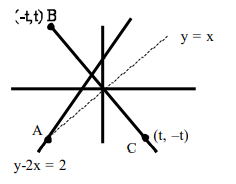
At $A x=y$
$Y-2 x=2$
$(-2,-2)$
Height from line $x + y =0$
$h=\frac{4}{\sqrt{2}}$
Area of $\Delta=\frac{\sqrt{3}}{4} \frac{ h ^2}{\sin ^2 60}=\frac{8}{\sqrt{3}}$
A
$p=T, q=T, r=F$
B
$p=T, q=F, r=T$
C
$p=F, q=T, r=F$
D
$p=T, q=F, r=F$

A
It has no solution if $\alpha=-1$ and $\beta \neq 2$
B
It has no solution for $\alpha=-1$ and for all $\beta \in R$
C
It has a solution for all $\alpha \neq-1$ and $\beta=2$
D
It has no solution for $\alpha=3$ and for all $\beta \neq 2$
Solution
$ D=\begin{vmatrix}\alpha & 2 & 1 \\ 2 \alpha & 3 & 1 \\ 3 & \alpha & 2\end{vmatrix}=0 \Rightarrow \alpha=-1,3 $
$ D_x=\begin{vmatrix}2 & 1 & 1 \\ 3 & 1 & 1 \\ \alpha & 2 & \beta\end{vmatrix}=0 \Rightarrow \beta=2 $
$ D_y= \begin{vmatrix}\alpha & 1 & 1 \\ 2 \alpha & 1 & 1 \\ 3 & 2 & \beta\end{vmatrix}=0$
$ D_z= \begin{vmatrix} \alpha & 2 & 1 \\ 2 \alpha & 3 & 1 \\ 3 & \alpha & \beta\end{vmatrix}=0 $
$ \beta=2, \alpha=-1 $
$\alpha=-1, \beta=2 $ Infinite solution
A
$\frac{11}{8}$
B
$\frac{3}{2}$
C
$\frac{9}{8}$
D
$\frac{5}{4}$
Solution
$f (\theta)=3\left(\sin ^4\left(\frac{3 \pi}{2}-\theta\right)+\sin ^4(3 x+\theta)\right)-2\left(1-\sin ^2 2 \theta\right) $
$ S =\left\{\theta \in[0, \pi]: f^{\prime}(\theta)=-\frac{\sqrt{3}}{2}\right\} $
$ \Rightarrow f(\theta)=3\left(\cos ^4 \theta+\sin ^4 \theta\right)-2 \cos ^2 2 \theta $
$ \Rightarrow f(\theta)=3\left(1-\frac{1}{2} \sin ^2 2 \theta\right)-2 \cos ^2 2 \theta $
$ \Rightarrow f(\theta)=3-\frac{3}{2} \sin ^2 2 \theta-2 \cos ^2 \theta$
$=\frac{3}{2}-\frac{1}{2} \cos ^2 2 \theta=\frac{3}{2}-\frac{1}{2}\left(\frac{1+\cos 4 \theta}{2}\right)$
$f(\theta)=\frac{5}{4}-\frac{\cos 4 \theta}{4}$
$ f^{\prime}(\theta)=\sin 4 \theta$
$ \Rightarrow f^{\prime}(\theta)=\sin 4 \theta=-\frac{\sqrt{3}}{2} $
$\Rightarrow 4 \theta= n \pi+(-1)^{ n } \frac{\pi}{3}$
$ \Rightarrow \theta=\frac{ n \pi}{4}+(-1)^{ n } \frac{\pi}{12}$
$ \Rightarrow \theta=\frac{\pi}{12},\left(\frac{\pi}{4}-\frac{\pi}{12}\right),\left(\frac{\pi}{2}+\frac{\pi}{12}\right),\left(\frac{3 \pi}{4}-\frac{\pi}{12}\right) $
$ \Rightarrow 4 \beta=\frac{\pi}{4}+\frac{\pi}{2}+\frac{3 \pi}{4}=\frac{3 \pi}{2} $
$ \Rightarrow \beta=\frac{3 \pi}{8} \Rightarrow f (\beta)=\frac{5}{4}-\frac{\cos \frac{3 \pi}{2}}{4}=\frac{5}{4}$
A
A and B
B
$B$ and $C$
C
B and D
D
A and C
Solution
$z_1=x_1+i y_1$
$z _2= x _2+ i y _2$
$\operatorname{Re}\left( z _1 z _2\right)= x _1 x _2- y _1 y _2=0$
$\operatorname{Re}\left( z _1+ z _2\right)= x _1+ x _2=0$
$x _1 \& x _2$ are of opposite sign
$y_1 \& y_2$ are of opposite sign
A
$\beta=-8$
B
$\beta=8$
C
$a=4$
D
$\alpha=1$
Solution
$ A ^2=3 A +\alpha I$
$ A ^3=3 A ^2+\alpha A$
$ A ^3=3(3 A +\alpha I )+\alpha A$
$ A ^3=9 A +\alpha A +3 \alpha I$
$ A ^4=(9+\alpha) A ^2+3 \alpha A $
$=(9+\alpha)(3 A +\alpha I )+3 \alpha A$
$ = A (27+6 \alpha)+\alpha(9+\alpha) $
$ \Rightarrow 27+6 \alpha=21 \Rightarrow \alpha=-1 $
$ \Rightarrow \beta=\alpha(9+\alpha)=-8$
A
$\frac{5}{36}$
B
$\frac{2}{15}$
C
$\frac{5}{24}$
D
$\frac{1}{6}$
Solution
Required probability $=1-\frac{D_{(15)}+{ }^{15} C_1 \cdot D_{(14)}+{ }^{15} C_2 D_{(13)}}{15 !}$
Taking $D _{(15)}$ as $\frac{15 \text { ! }}{e}$
$D _{(14)}$ as $\frac{14 \text { ! }}{e}$
$D _{(13)}$ as $\frac{13 !}{e}$
We get, $1-\left(\frac{\frac{15 !}{e}+15 \cdot \frac{14 !}{e}+\frac{15 \times 14}{2} \times \frac{13 !}{e}}{15 !}\right)$
$=1-\left(\frac{1}{e}+\frac{1}{e}+\frac{1}{2 e}\right)=1-\frac{5}{2 e} \approx .08$
A
$f(x)$ is many-one in $(-\infty,-1)$
B
$f(x)$ is one-one in $(-\infty, \infty)$
C
$f(x)$ is many-one in $(1, \infty)$
D
$f(x)$ is one-one in $[1, \infty)$ but not in $(-\infty, \infty)$
Solution
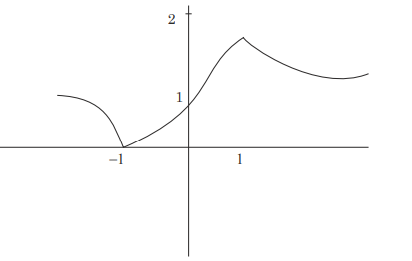
$ f(x)=\frac{(x+1)^2}{x^2+1}=1+\frac{2 x}{x^2+1} $
$ f(x)=1+\frac{2}{x+\frac{1}{x}}$
A
18
B
6
C
24
D
0
Solution
$ \begin{vmatrix} \lambda & \mu & 4 \\ -2 & 4 & -2 \\ 2 & 3 & 1 \end{vmatrix}=0$
$ \lambda(10)=\mu(2)+4(-14)=0 $
$ 10 \lambda-2 \mu=56$
$ 5 \lambda-\mu=28 .....$(1)
$ \frac{\vec{a} \cdot \vec{b}}{|\vec{b}|}=\sqrt{54}$
$\frac{-2 \lambda+4 \mu-8}{\sqrt{24}}=\sqrt{54} $
$ -2 \lambda+4 \mu-8=\sqrt{54 \times 24} .....$(2)
By solving equation (1) & (2)
$\Rightarrow \lambda+\mu=24$
A
$-\pi(\pi+2)$
B
$-\pi(\pi-2)$
C
$-2 \pi(\pi+2)$
D
$-2 \pi(\pi-2)$
Solution
$f(x)=x+\int\limits_0^{\pi / 2}(\sin x \cos y+\cos x \sin y) f(y) d y$
$f(x)=x+\int\limits_0^{\pi / 2}((\cos y f(y) d y) \sin x+(\sin y f(y) d y) \cos x) .......$(1)
On comparing with
$f(x)=x+\frac{a}{\pi^2-4} \sin x+\frac{b}{\pi^2-4} \cos x, x \in R$ then
$\Rightarrow \frac{a}{\pi^2-4}=\int\limits_0^{\pi / 2} \cos y f(y) d y .....$(2)
$\Rightarrow \frac{b}{\pi^2-4}=\int\limits_0^{\pi / 2} \sin y f(y) d y .....$(3)
Add (2) and (3)
$ \frac{a+b}{\pi^2-4}=\int\limits_0^{\pi / 2}(\sin y+\cos y) f(y) d y \ldots(4) $
$\frac{a+b}{\pi^2-4}=\int\limits_0^{\pi / 2}(\sin y+\cos y) f\left(\frac{\pi}{2}-y\right) d y \ldots(5) $
Add (4) and (5)
$ \frac{2(a+b)}{\pi^2-4} =\int\limits_0^{\pi / 2}(\sin y+\cos y)\left(\frac{\pi}{2}+\frac{(a+b)}{\pi^2-4}(\sin y+\cos y)\right) d y $
$ =\pi+\frac{a+b}{\pi^2-4}\left(\frac{\pi}{2}+1\right) $
$(a+b) =-2 \pi(\pi+2)$
A
$(2, \infty)-\{3\}$
B
$R -\{3\}$
C
$R -\{-1,3\}$
D
$(-1, \infty)-\{3\}$
Solution
$x-2>0 \Rightarrow x>2$
$x+1>0 \Rightarrow x>-1 $
$ x+1 \neq 1 \Rightarrow x \neq 0 \text { and } x>0$
Denominator
$ x^2-2 x-3 \neq 0 $
$ (x-3)(x+1) \neq 0$
$x \neq-1,3$
So Ans $(2, \infty)-\{3\}$
Answer: 60
Solution
$a _4 \cdot a _6=9 \Rightarrow\left( a _5\right)^2=9 \Rightarrow a _5=3 $
$ \& a _5+ a _7=24 \Rightarrow a _5+ a _5 r ^2=24 \Rightarrow\left(1+ r ^2\right)=8 \Rightarrow r =\sqrt{7} $
$ \Rightarrow a =\frac{3}{49} $
$ \Rightarrow a _1 a _9+ a _2 a _4 a _9+ a _5+ a _7=9+27+3+21=60$
Answer: 1
Solution
Coefficient of $x ^9$ in $\left(\alpha x^3+\frac{1}{\beta x}\right)={ }^{11} C_6 \cdot \frac{\alpha^5}{\beta^6}$
$\because$ Both are equal
$ \therefore \frac{11}{C_6} \cdot \frac{\alpha^5}{\beta^6}=-\frac{11}{C_5} \cdot \frac{\alpha^6}{\beta^5} $
$ \Rightarrow \frac{1}{\beta}=-\alpha $
$ \Rightarrow \alpha \beta=-1 $
$\Rightarrow(\alpha \beta)^2=1$
Answer: 10
Solution
$ \because f(1)=\frac{1}{5} \therefore f(2)=f(1)+f(1)=\frac{2}{5} $
$ f(2)=\frac{2}{5} f(3)=f(2)+f(1)=\frac{3}{5}$
$f(3)=\frac{3}{5} $
$ \therefore \displaystyle\sum_{n=1}^m \frac{f(n)}{n(n+1)(n+2)} $
$=\frac{1}{5} \displaystyle\sum_{n=1}^m\left(\frac{1}{n+1}-\frac{1}{n+2}\right) $
$=\frac{1}{5}\left(\frac{1}{2}-\frac{1}{3}+\frac{1}{3}-\frac{1}{4}+\ldots .+\frac{1}{m+1}-\frac{1}{m+2}\right)$
$ =\frac{1}{5}\left(\frac{1}{2}-\frac{1}{m+2}\right)=\frac{m}{10(m+2)}=\frac{1}{12} $
$ \therefore m=10$
Answer: 1120
Solution
$ t_{r+1}={ }^n C_r(2 x)^r$
$ \Rightarrow \frac{{ }^{ n } C_{r-1}(2)^{r-1}}{{ }^{ n } C_r(2)^{ r }}=\frac{2}{5}$
$ \Rightarrow \frac{\frac{n !}{(r-1) !(n-r+1) !}}{\frac{n !(2)}{r !(n-r) !}}=\frac{2}{5} $
$ \Rightarrow \frac{r}{n-r+1}=\frac{4}{5} \Rightarrow 5 r=4 n-4 r+4$
$ \Rightarrow 9 r=4(n+1) .....$(1)
$ \Rightarrow \frac{{ }^{ n } C_r(2)^{ r }}{{ }^{ n } C_{r+1}(2)^{r+1}}=\frac{5}{8} $
$ \Rightarrow \frac{\frac{n !}{ r !( n - r ) !}}{\frac{ n !}{(r+1) !(n-r-1) !}}=\frac{5}{4} \Rightarrow \frac{r+1}{n-r}=\frac{5}{4} $
$ \Rightarrow 4 r+4=5 n-5 r \Rightarrow 5 n-4=9 r \ldots$(2)
From (1) and (2)
$\Rightarrow 4 n+4=5 n-4 \Rightarrow n=8$
(1) $\Rightarrow r =4$
so, coefficient of middle term is
${ }^8 C _4 2^4=16 \times \frac{8 \times 7 \times 6 \times 5}{4 \times 3 \times 2 \times 1}=16 \times 70=1120$
Answer: 3
Solution
$ f ( x + y )= f ( x )+ f ( y )-1 $
$ f^{\prime}(x)=\displaystyle\lim _{h \rightarrow 0} \frac{f(x+h)-f(x)}{h} $
$ f^{\prime}(x)=\displaystyle\lim _{h \rightarrow 0} \frac{f(h)-f(0)}{h}=f^{\prime}(0)=2$
$f^{\prime}(x)=2 \Rightarrow d y=2 d x $
$ y =2 x + C $
$ x =0, y =1, c =1 $
$ y =2 x +1 $
$ |f(-2)|=|-4+1|=|-3|=3$
Answer: 355
Solution
The line $\frac{x+10}{1}=\frac{y-8}{-2}=\frac{z}{1}$ have a point $(-10,8,0)$ with d. r. $(1,-2,1)$
$ \because \text { the plane } a x+b y+3 z=2(a+b)$
$ \Rightarrow b=2 a$
$\&$ dot product of d.r.'s is zero
$\therefore a -2 b +3=0$
$\therefore a =1 \& b =2$
Distance from $(1,27,7)$ is
$c=\frac{1+54+21-6}{\sqrt{14}}=\frac{70}{\sqrt{14}}=5 \sqrt{14}$
$ \therefore a ^2+ b ^2+ c ^2=1+4+350$
$ =355$
Answer: 1436
Solution
No of 5 digit numbers starting with digit 1 $=5 \times 5 \times 5 \times 5=625$
No of 5 digit numbers starting with digit 2 $=5 \times 5 \times 5 \times 5=625$
No of 5 digit numbers starting with 31 $=5 \times 5 \times 5=125$
No of 5 digit numbers starting with 32 $=5 \times 5 \times 5=125$
No of 5 digit numbers starting with 33 $=5 \times 5 \times 5=125$
No of 5 digit numbers starting with 351 $=5 \times 5=25$
No of 5 digit numbers starting with 352 $=5 \times 5=25$
No of 5 digit numbers starting with 3531 $=5$
No of 5 digit numbers starting with 3532 $=5$
Before 35337 will be 4 numbers,
So rank of 35337 will be 1690
So, in descending order serial number will be $3125-1690+1=1436$
Answer: 9
Solution

$ \left|\frac{1}{2} \cdot 2 \sqrt{21} \begin{vmatrix} i & j & k \\ \alpha & 1 & \alpha+4 \\ 5 & 2 & 3\end{vmatrix} \frac{1}{\sqrt{25+4+9}}\right|=21 \sqrt{21} $
$ \sqrt{(2 \alpha+5)^2+(2 \alpha+20)^2+(2 \alpha-5)^2}=\sqrt{21} \sqrt{38} $
$\Rightarrow 12 \alpha^2+80 \alpha+450=798 $
$ \Rightarrow 12 \alpha^2+80 \alpha-348=0$
$ \Rightarrow \alpha=3 \Rightarrow \alpha^2=9$
Answer: 32
Solution

$ 245678 \rightarrow 72^{\text {th }} \text { word } $
$ 2+4+5+6+7+8=32$
Answer: 2