JEE Main Physics Question Paper with Solution 2019 April 9th Shift 2 - Afternoon
A
$ 6.67 \times 10^{-3} \; Wb$
B
$ 6.67 \times 10^{-4} \; Wb$
C
$ 3.67 \times 10^{-4} \; Wb$
D
$ 3.67 \times 10^{-3} \; Wb$
Solution
$\phi_{q} = \frac{\mu_{0} i_{1}R^{2}}{2\left(R^{2} +x^{2}\right)^{\frac{3}{2}}} \times\pi r^{2} = 10^{-3} $
$ \phi_{p} = \frac{\mu_{0}i_{2}r^{2}}{2\left(r^{2}+x^{2}\right)^{\frac{3}{2}}} \times\pi R^{2}$
$ \frac{\phi_{P}}{\phi_{Q} } = \frac{i_{2}}{i_{1}} . \frac{\left(R^{2} +x^{2}\right)^{\frac{3}{2}}}{\left(r^{2} +x^{2}\right)^{\frac{3}{2}}} = \frac{\phi_{P}}{10^{-3}} $
$ \frac{2}{3} = \frac{\phi_{P}}{10^{-3}} $
$ \phi_{P} = 6.67 \times10^{-4} $
A
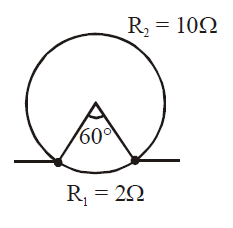
$\frac{12}{5} \Omega $
B
$\frac{5}{3} \Omega $
C
$\frac{5}{2} \Omega $
D
$\frac{7}{2} \Omega $
Solution
$R =\frac{\rho\ell^{2}}{A \ell D} d = \frac{\rho d \ell^{2}}{m}$
$ R \propto \ell^{2}$
$ R = 12\Omega $ (new resistance of wire)
$ R_{1} = 2 \Omega R_{2} = 10 \Omega $
$ R_{eq} = \frac{10 \times2}{10+2} = \frac{5}{3} \Omega$
A
0.2 ohm
B
0.002 ohm
C
0.02 ohm
D
0.5 ohm
Solution
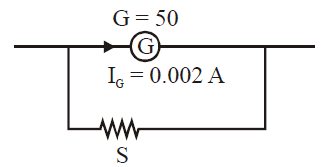
$S(0.5 - 0.002) = 50 \times 0.002$
$S = \frac{50 \times 0.002}{(0.5 - 0.002)} = \frac{0.1}{0.498} = 0.2 $
A
$a + \frac{b^2}{4c}$
B
$a + \frac{b^2}{c}$
C
$a + \frac{b^2}{2c}$
D
$a + \frac{b^2}{3c}$
Solution
$x =at +bt^{2} -ct^{3}$
$ v = \frac{dx}{dt}=a+2bt-3ct^{2} $
$ a= \frac{dv}{dt} =2b-6ct =0 \Rightarrow t = \frac{b}{3c} $
$ v_{\left(at t= \frac{b}{3c}\right)} = a +2b \left(\frac{b}{3c}\right)-3c\left(\frac{b}{3c}\right) $
$ =a +\frac{b^{2}}{3c} .$
A
$\sqrt{2} $
B
$\frac{4}{3}$
C
$\sqrt{3} $
D
$\frac{3}{2}$
Solution
$\frac{1}{f_{1}} = \frac{1}{2} \times\frac{2}{18} = \frac{1}{18} $
$ \frac{1}{f_{2}} = \frac{\left(\mu_{1} -1\right)}{-18} $
when $\mu_1$ is filled between lens and mirror
$ P= \frac{2}{18} - \frac{2}{18} \left(\mu_{1} - 1\right) = \frac{2-2\mu_{1} +2}{18} $
$ =F_{m} =- \left(\frac{18}{2-\mu_{1}}\right) $
$ 2=6-3\mu_{1} $
$ 3\mu_{1} = 4 $
$ \mu_{1} =4/3 $
A
$10^{-3}$
B
$10^{-1}$
C
$10^{-4}$
D
$10^{-2}$
Solution
$\tau =\vec{M} \times\vec{B} $
$ C \theta =i NAB $
$ 10^{-6} \times\frac{\pi}{180} = 10^{-3} \times10^{-4} \times175 \times B $
$ B =10^{-3} $ Tesla.
A

B

C

D

Solution
$\phi_{\text{outer}} \left(\mu_{0} nKte^{-\alpha t}\right) 4\pi R^{2}$
$ \varepsilon =\frac{-d\phi}{dt} =-Ce^{-\alpha t} \left[1-\alpha t\right]$
$ i_{\text{induced}} = \frac{-Ce^{-\alpha t} \left[1-at\right]}{\left(\text{Resistance}\right)} $
At $t=0 \,\,\,\,\,i_{\text{induced}} =-ve $
A
$10^{-3} K $
B
$10^{-4} K $
C
$10^{-1} K $
D
$10^{-5} K $
Solution
By law of conservation of energy
$\frac{1}{2} kx^2 = (m_1s_1+ m_2 s_2) \Delta T$
$\Delta T = \frac{16 \times 10^{-2}}{4384} = 3.65 \times 10^{-5}$ .
A
$\lambda_x + \lambda_y$
B
$\frac{\lambda_a \lambda_y}{\lambda_x + \lambda_y}$
C
$\frac{\lambda_x \lambda_y}{| \lambda_y - \lambda_x | }$
D
$\lambda_x - \lambda_y$
Solution
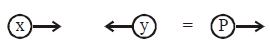
By momentum conservation
$P_x - P_y = P_P$
$\frac{h}{\lambda_{x}} - \frac{h}{\lambda_{y}} = \frac{h}{\lambda_{p}} $
$ \lambda_{p} = \frac{\lambda_{x}\lambda_{y}}{\left|\lambda_{y} -\lambda_{x}\right|} $
A
5 : 3
B
2 : 1
C
4 : 3
D
3 : 1
Solution
Magnification is $2$
If image is real, $x_1 = \frac{3f}{2}$
If image is virtual, $x_2 = \frac{f}{2}$
$\frac{x_1}{x_2} = 3: 1 $
A
$1.5 \times 10^{-7} \; rad$
B
$2.0 \times 10^{-7} \; rad$
C
$3.0 \times 10^{-7} \; rad$
D
$4.5 \times 10^{-7} \; rad$
Solution
Limit of resolution $= \frac{1.22\lambda}{d} $
$= \frac{1.22 \times600 \times 10^{-9}}{250 \times10^{-2} } $
$ = 2.9 \times10^{-7} \text{rad} $
A
2s
B
5s
C
2.5 s
D
3s
Solution
Given moment of inertia 'I' = 1.5 kgm$^2$
Angular Acc. "a" = $20\, Rad/s^2$
$KE =\frac{1}{2} I\omega^{2} $
$ 1200 = \frac{1}{2} 1.5 \times\omega^{2} $
$ \omega^{2} = \frac{1200\times2}{1.5} = 1600 $
$ \omega = 40 \text{rad}/s^{2} $
$ \omega =\omega_{0} +\alpha t $
$ 40=0+20t $
$ t=2\sec$

A
$OR$
B
$AND$
C
$NOR$
D
$NAND$
Solution
Method 1
Truth table can be formed as
A
B
Equivalent
0
0
0
0
1
1
1
0
1
1
1
1
Hence the Equivalent is "OR" gate.
Method 2
| A | B | Equivalent |
| 0 | 0 | 0 |
| 0 | 1 | 1 |
| 1 | 0 | 1 |
| 1 | 1 | 1 |

A
$15 \times 10^{-8} \; N$
B
$35 \times 10^{-8} \; N$
C
$10 \times 10^{-8} \; N$
D
$20 \times 10^{-8} \; N$
Solution
Force on the surface (25% reflecting and rest absorbing)
$F = \frac{25}{100} \left(\frac{2I}{C} \right)+ \frac{75}{100} \left(\frac{I}{C}\right) = \frac{125}{100}\left(\frac{I}{C}\right) $
$ =\frac{125}{100} \times\left(\frac{50}{3\times10^{8}} \right) = 20.83 \times10^{-8} N $
A
$37 \; cm^2$
B
$37.0 \; cm^2$
C
$37.03 \; cm^2$
D
$37.030 \; cm^2$
Solution
Total Area = $A_1 + A_2 + ...... A_7$
= $A + A + ......... 7$ times
= $37.03\, cm^2$.
Addition of $7$ terms all having $2$ terms beyond decimal, so final answer must have $2$ terms beyond decimal (as per rules of significant digits.)
A
proportional to carrier frequency
B
inversely proportional to modulation frequency
C
inversely proportional to carrier frequency
D
independent of both carrier and modulation frequency
Solution
The physical size of antenna of reciver and transmitter both inversely proportional to carrier frequency.
A
$E \propto \frac{1}{D}$
B
$E \propto \frac{1}{D^3}$
C
$E \propto \frac{1}{D^2}$
D
$E \propto \frac{1}{D^4}$
Solution
Electric field at $p = 2E_{1} \cos\theta_{1} -2E_{1}\cos\theta_{2} $
$ = \frac{2Kq}{\left(d^{2}+D^{2}\right)} \times\frac{D}{\left(d^{2}+D^{2}\right)^{1/2}} - \frac{2Kq}{\left[\left(2d\right)^{2}+D^{2}\right]} \times\frac{D}{\left[\left(2d\right)^{2}+D^{2}\right]^{1/2}} $
$ =2KqD \left[\left(d^{2}+D^{2}\right)^{-\frac{3}{2}} - \left(4d^{2} +D^{2}\right)^{-\frac{3}{2}} \right] $
$ = \frac{2KaD}{D^{3}} \left[\left(1- \frac{d^{2}}{D^{2}}\right)^{-3/2} -\left(1+ \frac{4d^{2}}{D^{2}}\right)^{-3/2}\right] $
Applying binomial approximation $ \because d < < D $
$ = \frac{2KqD}{D^{3}} \left[ 1- \frac{3}{2} \frac{d^{2}}{D^{2}} - \left(1- \frac{3\times4d^{2}}{2D^{2}}\right)\right] $
$ = \frac{2KqD}{D^{3}} \left[\frac{12}{2} \frac{d^{3}}{D^{2}} - \frac{3}{2} \frac{d^{2}}{D^{2}}\right] $
$ = \frac{9kqd^{2}}{D^{4}} $

A
A has one vibrational mode and B has two
B
Both A and B have a vibrational mode each
C
A is rigid but B has a vibrational mode
D
A has a vibrational mode but B has none
Solution
For A
$R = C_p - C_v = 7$
$C_{V} = \frac{fR}{2} = 22 \Rightarrow f= \frac{44}{7} = 6.3 $
$ f \simeq6 \begin{matrix} \to &5 \left(\text{Rotation}+\text{Translatioal}\right)\\ \to &1 \left(\text{Vibration}\right)\end{matrix} $
For B
$ R = C_{P} -C_{V} =9 $
$ C_{V} = \frac{fR}{2} = 21 \Rightarrow f= \frac{42}{9} $
$ f \simeq 5 \begin{matrix} \to &5 \left(\text{Rotation}+\text{Translatioal}\right)\\ \to &0 \left(\text{Vibration}\right)\end{matrix}$
A
40
B
100
C
25
D
50
Solution
$\vec{r} = 15t^{2} \hat{i} +\left(4-20 t^{2}\right)\hat{j} $
$ \vec{v} = \frac{d\vec{r}}{dt} =30 t \hat{i} + \left(-40t\right)\hat{j} $
$ \vec{a} = \frac{d \vec{v}}{dt} =30 \hat{i} - 40 \hat{j}$
$ \left|\vec{a}\right| = 50 m/s^{2} $
A
$T/R^2$ is a constant
B
$TR$ is a constant
C
$T^2/R^3$ is a constant
D
$T/R$ is a constant
Solution
$ m = \int^{R}_{0} \rho4\pi r^{2}dr $
$ m = 4\pi KR$
$ v \propto \sqrt{4\pi K} $
$ \frac{T}{R} = \frac{2\pi}{\sqrt{4\pi K}}$
A
$v / (2 \sqrt{2} )$
B
$2 \sqrt{2} v$
C
$ \sqrt{2} v$
D
$ v/ \sqrt{2} $
Solution
Linear momentum conservation
$m 2v + 2m v = m \times 0 + m \frac{v'}{\sqrt{2}} \times 2 $
$v' = 2 \sqrt{2} v $

A
0.5
B
0.7
C
0.6
D
0.8
Solution
In $1^{st}$ situation
$V_{b} \rho_{b}g = V_{s}\rho_{w}g $
$ \frac{V_{s}}{V_{b}} =\frac{\rho_{b}}{\rho_{w}} = \frac{4}{5} $ .....(i)
here $V_b$ is volume of block
$V_s$ is submerged volume of block
$\rho_b$ is density of block
$\rho_w$ is density of water
& Let $\rho_o$ is density of oil
finally in equilibrium condition
$ V_{b} \rho_{b} g = \frac{V_{b}}{2} \rho_{o} g + \frac{V_{b}}{2} \rho_{w}g $
$2\rho_{b} = \rho_{0} + \rho_{w} $
$\Rightarrow \frac{\rho_{o}}{\rho_{w}} = \frac{3}{5} = 0.6 $
A
2250 Hz
B
2060 Hz
C
2150 Hz
D
2300 Hz
Solution
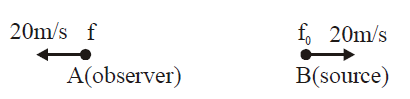
$f =\frac{v+v_{0}}{v-v_{s}} f_{0} (v_{0} \& v_{s} $ is taken $\oplus$ when approaching each other)
$2000 = \frac{340+\left(-20\right)}{340-\left(-20\right)} f_{0 }$
$ f_{0} = 2250 $ Hz.
A
$\frac{2v^2}{7g}$
B
$\frac{v^2}{g}$
C
$\frac{2v^2}{5g}$
D
$\frac{v^2}{2g}$
Solution
Applying Linear momentum conservation
$mv = (m + M) v_c$
$v_c = \frac{v}{5}$
applying work energy theorem
$ - mgh = \frac{1}{2} (m + M) v_c^2 - \frac{1}{2} mv^2$
solve , $h = \frac{2v^2}{5g}$

A
$6.04 \,eV$
B
$13.60 \,eV$
C
$54.40 \,eV$
D
$48.36 \,eV$
Solution
$E = -13.6 \frac{z^{2}}{n^{2}} eV$
As He+ is 1st excited state
$\therefore z = 2, n = 2$
$E = -13.6\, eV$
As total energy of $He^+$ in 1st excited state is $-13.6\, eV$, ionisation energy should be $+13.6\,eV$.
A
$\frac{\theta_{2} + \theta_{1}}{2} $
B
$ \frac{\theta_{1}}{10} + \frac{9\theta_{2}}{10}$
C
$ \frac{\theta_{1}}{3} + \frac{2\theta_{2}}{3}$
D
$ \frac{\theta_{1}}{6} + \frac{5\theta_{2}}{6}$
Solution
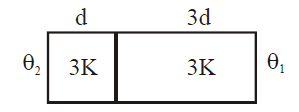
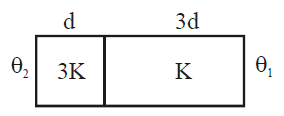
Let the temperature of interface be " $\theta$ "
$i_1 = i_2$ {Steady state conduction}
$\frac{3KA\left(\theta_{2}-\theta\right)}{d} = \frac{KA\left(\theta - \theta_{1}\right)}{3d} $
$\theta = \frac{9 \theta_{2}}{10} + \frac{\theta_{1}}{10} $
A
$\frac{M\omega_0}{M +3 m} $
B
$\frac{M\omega_0}{M + m} $
C
$\frac{M\omega_0}{M + 2 m} $
D
$\frac{M\omega_0}{M + 6 m} $
Solution
Applying angular momentum conservation, about axis of rotation
$L_i = L_f$
$\frac{ML^2}{12} \omega_0 = \left( \frac{ML^2}{12} + m \left( \frac{L}{2} \right)^2 \times 2 \right) \omega $
$\Rightarrow \; \omega = \frac{M \omega_0}{M + 6m}$
A
$\frac{V}{K + n}$
B
V
C
$\frac{(n + 1) V}{(K + n)}$
D
$\frac{nV}{K + n}$
Solution
Total charge of the system = $CV + nCV$
$= (n + 1)CV$
After the insertion of dielectric of constant $K$
New potential (common)
$V_C = \frac{total \; charge}{total \; capacitance}$
$ = \frac{( n + 1) CV}{KC + nC} = \frac{(n + 1) V}{K + n}$


A
$10^{-5} \Omega m$
B
$10^{-6} \Omega m$
C
$10^{-7} \Omega m$
D
$10^{- 8} \Omega m$
Solution
$\rho = \frac{m}{ne^2 \tau}$
$ = 1.67 \times 10^{-8} \Omega m $
A
320 m/s, 120 Hz
B
180 m/s, 80 Hz
C
180 m/s, 120 Hz
D
320 m/s, 80 Hz
Solution
$3\left(\frac{v}{2\ell}\right) =240 $
$ 3 \frac{v}{2\times2} = 240 $
$v = 320\, m/s$
fundamental frequency $ = \frac{v}{2\ell} = \frac{320}{2\times2} = 80 $
JEE Main Chemistry Question Paper with Solution 2019 April 9th Shift 2 - Afternoon
A
(B) < (C) < (D) < (A)
B
(A) < (B) < (D) < (C)
C
(B) < (A) < (D) < (C)
D
(B) < (C) < (A) < (D)
Solution
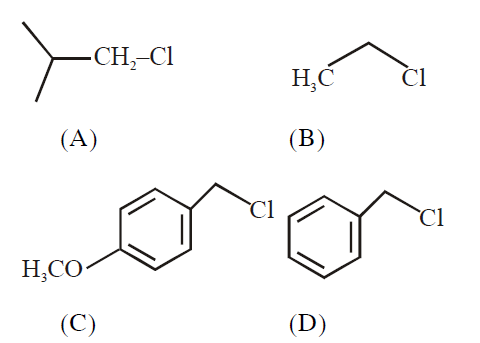
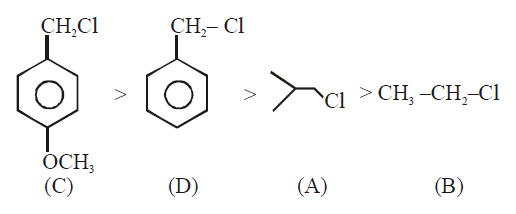
$S_N1$ Reactivity order
Order $C > D > A > B$
A
bauxite
B
siderite
C
calamine
D
malachite
Solution
1. Bauxite- $AlO _{ x }( OH )_{3-2 x }$ where $0 < x < 1$
2. Siderite $- FeCO _3$
3. Calamine $- ZnCO _3$
4. Malachite $- CuCO _3 \cdot Cu ( OH )_2$
A
8
B
12
C
- 12
D
-8
Solution
$\Delta U = q + w$
$q = - 2\,kJ, W = 10\,kJ$
$\Delta U = 8\,kJ$
A
quartz
B
kieselguhr
C
cristobalite
D
tridymite
Solution
Kieselguhr is amorphous form of silica, it's a fact


A
The electron can be found at a distance $2a_0$ from the nucleus
B
The probability density of finding the electron is maximum at the nucleus.
C
The magnitude of potential energy is double that of its kinetic energy on an average.
D
The total energy of the electron is maximum when it is at a distance $a^0$ from the nucleus.


A
6 and 8
B
8 and 6
C
8 and 8
D
6 and 6
Solution
Towards common transition element and inner transition metal ion given ligand can have maximum denticities of 6 and 8 respectively.
A
(I), (II) and (III)
B
(II) and (III) only
C
(I) and (III) only
D
(I) and (II) only
Solution
All statements are correct
$B_2O_3 \rightarrow$ acidic
$Al_2O_3 \; \& \; Ga_2O_3$ are amphoteric oxides of In & Tl are basic
A
$O_2$
B
$NO$
C
$B_2$
D
$CO$
Solution
$O_2,NO,B_2$ are paramagnetic according to M.O.T. where as $CO$ is diamagnetic.
A
Lys-Asp
B
Ser-Lys
C
Gln-Asp
D
Asp-Gln
Solution
Lysine has $-NH_2$ group hence gives $\oplus ve$ carbyl amine test and serine has $-OH$ group hence gives $\oplus ve$ serric ammonium nitrate test

A
Only the reason is correct.
B
Both the assertion and reason are correct and the reason is the correct explanation for the assertion.
C
Only the assertion is correct.
D
Both the assertion and reason are correct, but the reason is not the correct explanation for the assertion.
Solution
Assertion is correct as Haemetite ore is used for extraction of Fe.
Haemetite is an oxide ore so reason is incorrect
A
2.0 pm
B
2.0 nm
C
1.0 pm
D
0.1 nm
Solution
Millimoles $= 10 \times 10^{-3} = 10^{-2} $
Moles = $10^{-5}$
No. of molecules = $6 \times 10^{23} \times 10^{-5} = 6 \times 10^{+18 }$ surface area occupied by one molecule
$= \frac{0.24}{6\times10^{18} } = 0.04 \times10^{-18 } cm^{2} $
$ 4 \times10^{-20} =a^{2}$
$ a = 2\times10^{-10}cm =2pm$

A
C is the thermodynamically stable product.
B
Formation of A and B from C has highest enthalpy of activation.
C
D is kinetically stable product.
D
Activation enthalpy to form C is $5kJ \; mol^{-1}$ less than that to form D.
Solution
A + B $\to$ C + D
Activation enthalpy for $C = 20 - 5 = 15\,kJ/mol$
Activation enthalpy for $D = 15 - 5 = 10\,kJ/mol$

A
Ne
B
Ar
C
Xe
D
Kr
Solution
As $b \uparrow \; \Rightarrow $ slope $\uparrow$
Hence, Xe, will have highest slope
A
0.20
B
0.05
C
0.10
D
0.15
Solution
0.1 eq. of $Ni^{+2}$ will be discharged.
No. of eq = (No of moles) $\times$ (n-factor)
0.1 = (No. of moles) $\times$ 2
No. of moles of Ni = $\frac{0.1}{2} = 0.05 $
A
Acetone as substrate and methanol in stoichiometric amount
B
Propanal as substrate and methanol in stoichiometric amount
C
Acetone as substrate and methanol in excess
D
Propanal as substrate and methanol in excess
Solution
Acetone as substrate is less rective than propanal towards neucleophilic addition.

A
chain and dimeric
B
chain and chain
C
dimeric and dimeric
D
dimeric and chain
Solution
$BeCl_2$ exist as $(BeCl_2)_{n}$ polymeric chain in solid form, while $BeCl_2$ exist as dimer $(BeCl_2)_2$ in vapour phase.
A

B

C

D

Solution
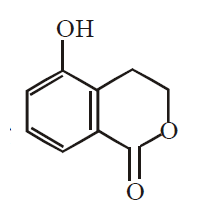
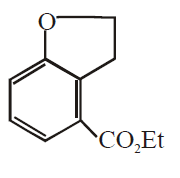
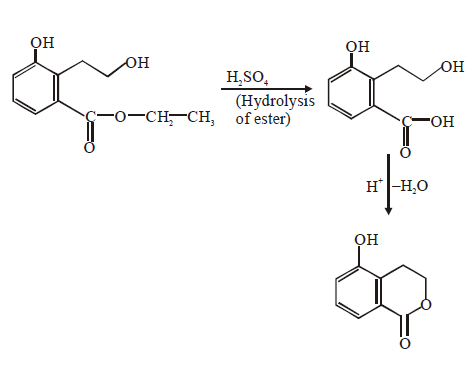
PE diagram for $S_N1$
$S_N1$ is two step reaction where in step (1) formation of carbocation is RDS

A
berkelium (Bk) and californium (Cf)
B
nobelium (No) and lawrencium (Lr)
C
actinium (Ac) and thorium (Th)
D
neptunium (Np) and plutonium (Pu)
Solution
Np and Pu show maximum no. of oxidations states starting from +3 to +7 all oxidation states.
A
0.12 K
B
0.36 K
C
0.18 K
D
0.24 K
Solution
$K_f$ = $4\, K-kg/mol$
$m = 0.03\, mol/kg$
$i = 3$
$\Delta T_f = iK_f \times m$
$ \Delta T_f = 3 \times 4 \times 0.03 = 0.3 6K$
A
Neurotransmitter
B
Antidepressant
C
Antihistamine
D
Antacid
Solution
Nor adrenaline is a neutro transmitter and it belongs to catecholamine family that fanctions in brain & body as a hermone & neutro transmitter.
A
$C_6H_5SO_2Cl$
B
$C_6H_5COCl$
C
$SOCl_2$
D
$(COCl)_2$
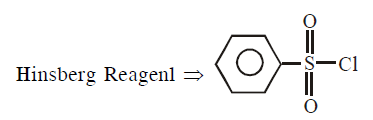
Solution
[Benzene Sulphonyl chloride]
A
troposphere
B
mesosphere
C
stratosphere
D
thermosphere
Solution
It's a fact, the layer of atmosphere between 10km to 50km above sea level is called as stratosphere.
A
lowest dissociation enthalpy
B
strongest van der Waals' interactions
C
strongest hydrogen bonding
D
lowest ionic character
Solution
HF has highest boiling point among hydrogen halides because it has strongest hydrogen bonding
A
1.08
B
1.48
C
1.51
D
1.35
Solution
$\frac{W}{W} \% = 20$
$100\, gm$ solution has $20\, gm\, KI$
$80 \,gm$ solvent has $20\, gm\, KI$
$ m = \frac{\frac{20}{166}}{\frac{80}{1000}} = \frac{20\times1000}{166\times80} = 1.506 \simeq 1.51 \,mol/kg$
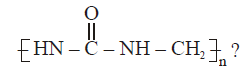
A
Formaldehyde
B
Ammonia
C
Methylamine
D
N-Methyl urea
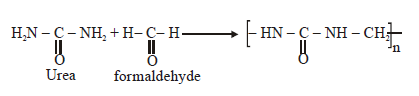
A
(I) and (II) only
B
(I), (II) and (III)
C
(I) and (III) only
D
(II) and (III) only
Solution
Based on NCERT, statement of limitations of VBT, I & III are correct


A

B

C

D

Solution
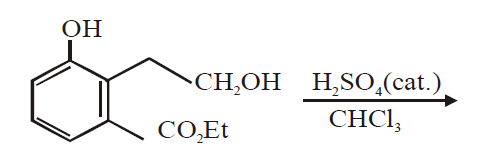
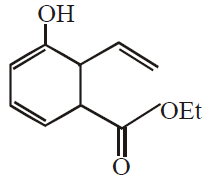
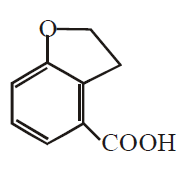
OH is activating and ortho para directing group towards ESR

JEE Main Mathematics Question Paper with Solution 2019 April 9th Shift 2 - Afternoon
A
$ 2 \sqrt{2} + 1 $
B
$ 2 \sqrt{2} -1 $
C
$ \sqrt{2} + 1 $
D
$ 2 \sqrt{2} - 1 $
Solution
$T:y \left(\beta\right) = \frac{1}{2} \left(x+\beta^{2}\right)$
$ 2y \beta=x+\beta^{2} $
$ y=\left(\frac{1}{2\beta}\right) x +\frac{\beta}{2} $
$ m = \frac{1}{2\beta} ; C = \frac{\beta}{2}$
$ \frac{\beta}{2} = \pm \sqrt{\frac{1}{4\beta^{2}} + \frac{1}{2}} $
$ \frac{\beta^{2}}{4} = \frac{1}{4\beta^{2}} + \frac{1}{2} $
$ \frac{\beta^{2}}{4} = \frac{1}{4\beta^{2}} + \frac{1}{2} \frac{\beta^{2}}{4} = \frac{1+2\beta^{2}}{4\beta^{2}}$
$ \Rightarrow \beta^{4} -2\beta^{2} -1 = 0 $
$ \left(\beta^{2} -1\right)^{2} = 2$
$ \beta^{2} -1 = \sqrt{2} $
$ \beta^{2} = \sqrt{2}+1 $

A
190
B
262
C
225
D
157
Solution
$\frac{n\left(n+1\right)}{2} +99 =\left(n-2\right)^{2} $
$ n^{2} + n + 198 = 2\left(n^{2} + 4 - 4n\right)$
$ n^{2} - 9n - 190 = 0 $
$ n^{2} - 19n + 10 - 190 = 0$
$ n\left(n - 19\right) + 10\left(n - 19\right) = 0$
$n = 19$
A
$0$
B
$2 f'(2)$
C
$12 f '(2)$
D
$24 f '(2)$
Solution
$\displaystyle\lim{x\to2} \frac{\int^{f\left(x\right)}_{6} 2t dt }{x-2} $
L Hopital Rule
$ \displaystyle\lim_{x\to2} \frac{2f \left(x\right)f '\left(x\right)}{1} = 2f \left(2\right) f '\left(2\right) 12f '\left(2\right)$
A
$\frac{3}{4}$
B
-4
C
$\frac{1}{2}$
D
$ - \frac{1}{4}$
Solution
$\begin{pmatrix}2&3&-1\\ 1&K&-2\\ 2&-1&1\end{pmatrix} = 0 $
By solving $ K = \frac{9}{2} $
$ 2x+3y-z=0 $ .....(1)
$ x+ \frac{9}{2} y-2z=0 $ ...(2)
$ 2x - y + z = 0 $ ....(3)
$ \left(1\right)-\left(3\right) \Rightarrow 4y - 2z = 0 $
$ 2y = z$ ...(4)
$ \frac{y} {z} = \frac{1}{2} $ ...(5)
put z from eqn. (4) into (1)
$ 2x + 3y - 2y = 0 $
$ 2x + y = 0 $
$ \frac{x}{y} = - \frac{1}{2} $ ....(6)
$ \frac{\left(6\right)}{\left(5\right)} \frac{z}{x} = - 4 $
$ \frac{x}{y} + \frac{y}{z} + \frac{z}{x} + K = \frac{1}{2} $
A
(-4, 6)
B
(6, -2)
C
(-6, 4)
D
(4, -2)
Solution
Circle touches internally
$C_1(0, 0); r_1 = 2$
$C_2 : (-3, -4); r_2 = 7$
$C_1C_2 = |r_1 - r_2|$
$S_1 - S_2 = 0 \; \Rightarrow $ eqn. of common tangent
$6x + 8y - 20 = 0$
$3x + 4y = 10$
$(6, -2)$ satisfy it
A
-25
B
25
C
-36
D
-35
Solution
$a - d + a + a + d = 33$ $\Rightarrow $ $a = 11$
$a(a^2 - d^2) = 1155$
$121 - d^2 = 105$
$d^2 = 16 \; \Rightarrow \; d = \pm 4$
If $d = 4$ then Ist term = $7$
If $d = -4$ then Ist term = $15$
$T_{11} = 7 + 40 = 47$
Q7. The value of the integral $\int\limits^{1}_{0} x \cot^{-1} \left(1-x^{2} + x^{4}\right)dx $ is :
A
$\frac{\pi}{4} - \frac{1}{2} \log_{e}2$
B
$\frac{\pi}{2} - \log_{e}2$
C
$\frac{\pi}{2} - \frac{1}{2} \log_{e}2$
D
$\frac{\pi}{4} - \log_{e}2$
Solution
$I = \int^{1}_{0} x \tan \left(\frac{1}{1+x^{2}\left(x^{2}-1\right)}\right)dx$
$ I = \int^{1}_{0} x \left(\tan^{-1}x^{2} - \tan^{-1}\left(x^{2}-1\right)\right)dx $
$ x^{2} =t \Rightarrow 2xdx =dt $
$ I = \frac{1}{2} \int^{1}_{0} \left(\tan^{-1} t - \tan^{-1} \left(t-1\right)\right)dx $
$ = \frac{1}{2} \int^{1}_{0} \tan^{-1} t dt - \frac{1}{2} \int^{1}_{0} \tan^{-1} \left(t-1\right)dt $
$ = \frac{1}{2} \int^{1}_{0} \tan^{-1} t dt - \frac{1}{2} \int^{1}_{0} \tan^{-1} dt = \int^{1}_{0} \tan^{-1} dt $
$ \tan^{-1} t = \theta \Rightarrow t = \tan\theta $
$ dt = \sec^{2} \theta d\theta$
$ \int^{\pi/4}_{0} \theta .\sec^{2} \theta d \theta $
$ I = \left(\theta. \tan\theta\right)^{\pi/4}_{0} - \int^{\pi/4}_{0} \tan \theta d\theta $
$ = \left(\frac{\pi}{4} - 0\right) - ln \left(\sec\theta\right) ^{\pi/4}_{0} $
$ = \frac{\pi}{4} - \left(\ell n \sqrt{2} - 0\right) $
$ = \frac{\pi}{4} - \frac{1}{2} \ell n2$
Q8. The value of $\sin \; 10^{\circ} \; \sin 30^{\circ} \; \sin 50^{\circ} \; \sin 70^{\circ}$ is :-
A
$\frac{1}{36}$
B
$\frac{1}{32}$
C
$\frac{1}{18}$
D
$\frac{1}{16}$
Solution
$\left(\sin10^{\circ} \sin30^{\circ} \sin70^{\circ}\right)\sin30^{\circ} $
$ \frac{1}{4} \left(\sin30^{\circ}\right) = \frac{1}{4} . \frac{1}{4} = \frac{1}{16}$
A
$ 5\,I m (\omega) < 1 $
B
$ 4 \,Im (\omega) > 5 $
C
$ 5 \,Re\, (\omega) > 1 $
D
$ 5 \,Re (\omega) > 4 $
Solution
$\left|z\right| < 1 $
$ 5\omega\left(1-z\right)=5+3z $
$ 5\omega - 5\omega z = 5 +3z $
$ z = \frac{5\omega-5}{3+5\omega}$
$ \left|z \right| = 5 \left|\frac{\omega-1}{3+5\omega} \right|<1 $
$ 5 \left|\omega-1\right|< \left|3+5\omega \right| $
$ 5 \left|\omega-1\right| < 5 \left|\omega+ \frac{3}{5}\right| $
$ \left|\omega-1\right| < 5 \left|\omega - \left( - \frac{3}{5}\right)\right| $

A
964
B
625
C
227
D
232
Solution
$\frac{^{n}C_{r-1}}{^{n}C_{r}} = \frac{2}{15} $
$ \frac{\frac{n!}{\left(r-1\right)!\left(n-r+1\right)!}}{\frac{n!}{r!\left(n-r\right)!}} = \frac{2}{15} $
$ \frac{r}{n-r+1} = \frac{2}{15} $
$ 15r =2n-2r+2 $
$ 17r = 2n+2 $
$ \frac{^{n}C_{r}}{^{n}C_{r+1}} = \frac{15}{70} $
$ \frac{\frac{n!}{r!\left(n-r\right)!}}{\frac{n!}{\left(r+1\right)!\left(n-r-1\right)!}} = \frac{3}{14}$
$ \frac{r+1}{n-r} = \frac{3}{14} $
$ 14r +14 =3n -3r $
$ 3n - 17r =14$
$ \frac{2n-17r =- 2 }{n=16} $
$ 17r=34, r = 2 $
${^{16}C_{1}} , {^{16}C_{2}} , {^{16}C_{3}} $
$ \frac{^{16}C_{1} + ^{16}C_{2} + ^{16}C_{3}}{3 } = \frac{16+120+560}{3} $
$\frac{680+16}{3} = \frac{696}{3} = 232 $
A
$ - \frac{\pi^2}{4\sqrt{3}}$
B
$ - \frac{\pi^2}{2}$
C
$ - \frac{\pi^2}{2\sqrt{3}}$
D
$\frac{\pi^2}{2\sqrt{3}}$
Solution
$\frac{dy}{dx} -y \tan x = 6x \sec x $
$ y\left(\frac{\pi}{3}\right) = 0 ; y \left(\frac{\pi}{6}\right) = 7 $
$ e^{\int pdx} = e^{-\int\tan xdx} = e^{\ell n \cos x} = \cos x $
$ y.\cos x = \int6x \sec x \cos x dx $
$ y.\cos x = \frac{6x^{2}}{2} + C $
$ y = 3x^{2}\sec x + C \sec x $
$ 0=3 . \frac{\pi^{2}}{9} .\left(2\right)+C\left(2\right) $
$ 2C = \frac{-2\pi^{2}}{3} \Rightarrow C = - \frac{\pi^{2}}{3} $
$ y\left(\pi/6\right) = 3. \frac{\pi^{2}}{36} . \left(\frac{2}{\sqrt{3}}\right) + \left(\frac{2}{\sqrt{3}}\right) . \left(- \frac{\pi^{2}}{3}\right) $
$ \Rightarrow y = - \frac{\pi^{2}}{2\sqrt{3}} $
A
$\frac{2}{5}$
B
$\frac{2}{\sqrt{5}}$
C
$\frac{\sqrt{2}}{5}$
D
$\sqrt{\frac{2}{5}}$
Solution
$\left(\frac{-1}{a-1}\right)\left(\frac{-2}{a^{2}} \right) = - 1 $
$ 2= -\left(a^{2}\right)\left(a-1\right) $
$ a^{3} -a^{2} + 2 =0 $
$ \left(a+1\right)\left(a^{2} - 2a +2 \right) = 0 $
$ \therefore a =- 1 $
$\left.\begin{aligned} L_1 : x -2 y + 1 = 0 \\ L_2 : 2x +y - 1 = 0 \end{aligned}\right\rbrace $
$ 0\left(0,0\right) P\left(\frac{1}{5}, \frac{3}{5}\right) $
$ OP = \sqrt{\frac{1}{25} + \frac{9}{25}} = \sqrt{\frac{10}{25}} = \sqrt{\frac{2}{5}} $
A
$2 / \pi $
B
$1 / 5 \pi $
C
$1/ 10 \pi $
D
$1/ 15 \pi $
Solution
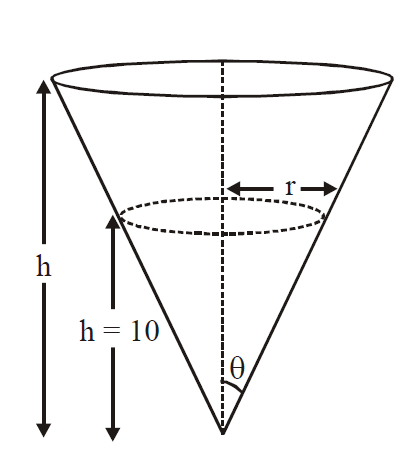
$\tan\theta = \frac{1}{2} = \frac{r}{h} $
$ r = \frac{h}{2} $
$V = \frac{1}{3} \pi r^{2}h $
$ V = \frac{1}{3} \pi. \frac{h^{3}}{4} $
$\frac{dV}{dt} = \frac{\pi}{12} \left(3h\right)^{2} \left(\frac{dh}{dt}\right) $
$ 5 = \frac{\pi}{4} .\left(100\right) \frac{dh}{dt} \Rightarrow \frac{dh}{dt} = \frac{1}{5\pi} $
A
$\frac{5}{2}\left(2+\sqrt{3}\right) $
B
$ 5( \sqrt{3} + 1)$
C
$ 5( 2 + \sqrt{3} )$
D
$ 10 ( \sqrt{3} - 1)$
Solution
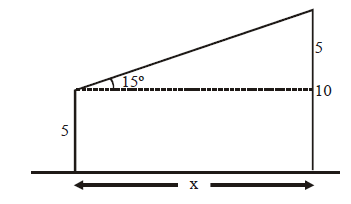
$\tan 15^{\circ} = \frac{5}{x}$
$ 2 - \sqrt{13} = \frac{5}{x} $
$ x=5 \left(2+\sqrt{3}\right) $
A
$ 2 \sqrt{34}$
B
$ \sqrt{34}$
C
6
D
$ \sqrt{17}$
Solution
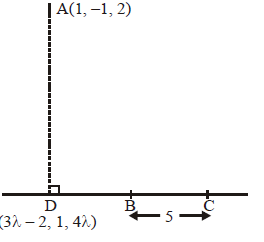
$\overrightarrow{AD} .\left(3\hat{i} +4\hat{k}\right) = 0 $
$ 3\left(3\lambda-3\right)+0+4\left(4\lambda-2\right)=0 $
$\left(9\lambda-9\right)+\left(16\lambda-8\right)=0 $
$25\lambda=17 \Rightarrow \lambda = \frac{17}{25} $
$ \therefore \overrightarrow{AD} = \left(\frac{51}{25} -3\right)\hat{i} +2 \hat{j} + \left(\frac{68}{25} -2\right) \hat{k} $
$= \frac{24}{ 25} \hat{i} +2 \hat{j} +\frac{18}{25} \hat{k} $
$ \left|\overrightarrow{AD}\right| = \sqrt{\frac{576}{625} +4+ \frac{324}{625}} $
$ = \sqrt{\frac{900}{625} + 4} = \sqrt{\frac{3400}{625}} $
$= \sqrt{34} . \frac{10}{25} = \frac{2}{5} \sqrt{34} $
Area of $ \Delta = \frac{1}{2} \times5 \times\frac{2\sqrt{34}}{5} = \sqrt{34} $
A
6
B
2
C
3
D
4
Solution
$A^{T}A =3I_{3} $
$ \begin{pmatrix}0&2x&2x\\ 2y&y&-y\\ 1&-1&1\end{pmatrix}\begin{pmatrix}0&2y&1\\ 2x&y&-1\\ 2x&-y&1\end{pmatrix} = \begin{pmatrix}3&0&0\\ 0&3&0\\ 0&0&3\end{pmatrix} $
$ \begin{pmatrix}8x^{2}&0&0\\ 0&6y^{2}&0\\ 0&0&3\end{pmatrix} = \begin{bmatrix}3&0&0\\ 0&3&0\\ 0&0&3\end{bmatrix} $
$ 8x^{2}= 3 $
$ 6y^{2}=3 $
$ x^{2} =3/8 $
$ y^{2} =1/2 $
$ x = \pm \sqrt{\frac{3}{8}} ; y= \pm \sqrt{\frac{1}{2}} $
A
$4 \pi ( 2 - \sqrt{2})$
B
$8\pi ( 3 - 2 \sqrt{2})$
C
$4 \pi ( 3 + \sqrt{2})$
D
$8 \pi ( 2 - \sqrt{2})$
Solution
Equation of circle is
$\left(x-1\right)^{2} +\left(y-2\right)^{2} +\lambda\left(x-y+1\right)=0$
$ \Rightarrow x^{2} +y^{2} +x\left(\lambda-2\right)+y\left(-4-\lambda\right) +\left(5+\lambda\right) = 0$
As cirlce touches x axis then $ g^{2} -c=0 $
$ \frac{\left(\lambda-2\right)^{2}}{4} = \left(5+\lambda\right)$
$ \lambda^{2} + 4-4\lambda=20 +4\lambda $
$ \lambda^{2} -8\lambda-16 =0 $
$ \lambda = \frac{8\pm \sqrt{128}}{2} $
$ \lambda = 4 \pm4\sqrt{2} $
Radius $ = \left|\frac{\left(-4-\lambda\right)}{2}\right|$
Put $\lambda $ and get least radius.

A
$\frac{2}{5-\pi} $
B
$\frac{2}{\pi - 5 } $
C
$\frac{2}{\pi + 5 } $
D
$\frac{ - 2}{\pi + 5 } $
Solution
$a\left|\pi-5\right|+1 = b \left|5-\pi\right| +3$
$ a\left(5-\pi\right)+1 =b\left(5-\pi\right)+3 $
$ \left(a -b\right)\left(5-\pi\right) = 2 $
$ a-b = \frac{2}{5-\pi}$

A
Both $\displaystyle\lim_{x \to 4-} f(x)$ and $\displaystyle\lim_{x \to 4+} f(x)$ exist but are not equal
B
$\displaystyle\lim_{x\to 4-} f(x)$ exists but $\displaystyle\lim_{x \to 4+} f(x)$ does not exist
C
$\displaystyle\lim_{x\to 4 +} f(x) $ exists but $\displaystyle\lim_{x\to 4-} f(x)$ does not exist
D
$f$ is continuous at $x = 4$
Solution
$f\left(x\right) =\left[x\right] - \left[\frac{x}{4}\right] $
$ \lim_{x\to4+} f\left(x\right) =\lim_{x\to4+} \left(\left(\left[x\right] - \left[\frac{x}{4}\right]\right)\right) = 4-1 =3 $
$ \lim_{x\to4+} f\left(x\right)= \lim_{x\to4-} \left(\left[x\right]- \frac{x}{4}\right) =3-0 =3 $
$ f\left(x\right) = 3 $
$ \therefore $ continuous at x = 4
A
$\sec x - \tan x - \frac{1}{2} $
B
$ x \sec x + \tan x + \frac{1}{2} $
C
$\sec x + x \tan x - \frac{1}{2} $
D
$\sec x + \tan x + \frac{1}{2} $
Solution
$\int e^{\sec x} \left(\sec x \tan x f\left(x\right)+\left(\sec x \tan x+\sec^{2}x \right)dx\right) $
$ =e^{\sec x }f\left(x\right)+C $
Diff. both sides w.r.t. 'x'
$ e^{\sec x} \left(\sec x \tan x f\left(x\right) +\left(\sec x \tan x+\sec^{2}x\right)\right) $
$=e^{\sec x}.\sec x \tan x f\left(x\right)+e^{\sec x} f'\left(x\right) $
$ f'\left(x\right) =\sec^{2}x +\tan x \sec x $
$ \Rightarrow f\left(x\right) =\tan x +\sec x +c $
A
$ 8 \sqrt{3}$
B
$ 4 \sqrt{3}$
C
$10 \sqrt{5}$
D
$8 \sqrt{5}$
Solution
$SOR = \frac{3}{m^{2} +1} \Rightarrow \left(S.O.R\right)_{max} = 3 $
when $m = 0$
$ \alpha+\beta=3 $
$ \alpha\beta = 1 $
$ \left|\alpha^{2} -\beta^{2}\right| =\left| \left|\alpha-\beta\right|\left(\alpha^{2} + \beta^{2} +\alpha\beta\right) \right| $
$ = \left|\sqrt{\left(\alpha-\beta\right)^{2}-\alpha\beta} \left(\left(\alpha+\beta\right)^{2} -\alpha\beta\right)\right| $
$ = \left|\sqrt{9-4} \left(9-1\right)\right| $
$= \sqrt{5} \times8 $

A
12.8
B
13.5
C
13.9
D
13
Solution
Let population = $100$
$n(A) = 25$
$n(B) = 20$
$n (A \cap B) = 8 $
$ n (A \cap \bar{B}) = 17$
$ n (\bar{A} \cap B) = 12$
$\frac{30}{100} \times 17 + \frac{40}{100} \times 12 + \frac{50}{100} \times 8$
$5.1 + 4.8 + 4 = 13.9$
A
$ 63 \sqrt{5}$
B
$ 205 \sqrt{5}$
C
$ 17 / \sqrt{5}$
D
$ 11 / \sqrt{5}$
Solution
$\lambda\left(x+y+z-6\right) +2x+3y+z+5=0 $
$\left(\lambda+2\right)x+\left(\lambda+3\right)y+\left(\lambda+1\right)z+5 -6\lambda=0 $
$ \lambda+1 =0 \Rightarrow \lambda=-1 $
$ P:x +2y +11 =0 =\frac{11}{\sqrt{5}} $
A
F, T, T
B
T, F, F
C
T, T, F
D
F, F, F
Solution
$P \; \Rightarrow (q \vee r) : F$
$P : T q \vee r : F$
$P : T : q : F : r : F$
A
$( 1 , 2 ) \cup (2, \infty)$
B
$( - 1 , 0 ) \cup (1, 2) \cup (3, \infty) $
C
$( - 1 , 0 ) \cup (1, 2) \cup (2, \infty) $
D
$( - 2 , -1 ) \cup ( -1, 0) \cup (2, \infty) $
Solution
$ 4 - x^2 \ne 0 ; x^3 - x > 0 $
$\therefore \; D_f \in (-1 , 0) \cup (1,2) \cup (2, \infty)$

Q26. The sum of the series$ 1 + 2 \times 3 + 3 \times 5+4 \times 7 +.... $ upto $11^{th}$ term is :-
A
915
B
946
C
945
D
916
Solution
$T_{r} = r\left(2r -1\right) $
$ S = \sum2r^{2} -\sum r $
$ S = \frac{2.n\left(n+1\right)\left(2n+1\right)}{6} - \frac{n\left(n+1\right)}{2}$
$ S_{11} = \frac{2}{6} .\left(11\right)\left(12\right)\left(23\right) - \frac{11\left(12\right)}{2} =\left(44\right)\left(23\right)-66 = 946 $
A
7/3
B
9/4
C
7/2
D
8/3
Solution
$\frac{34+x}{2} =35 $
$ x=36 $
$ 42 = \frac{10+22+26+29+34+36+42+67+70+y}{10} $
$ 420-336 =y \Rightarrow y = 84 $
$\frac{y}{x} = \frac{84}{36} = \frac{7}{3} $
A
$\frac{53}{3}$
B
18
C
30
D
16
Solution
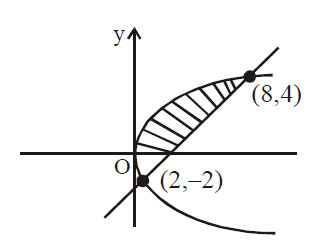
$y^{2} = 2x $
$ x-y-4 = 0 $
$ \left(x-4\right)^{2} = 2x $
$ x^{2} +16-8x-2x=0 $
$ x^{2} -10x+16=0 $
$ x=8,2 $
$ y =4,-2 $
$ A = \int^{4}_{-2} \left(y+4 - \frac{y^{2}}{2}\right)dy $
$ = \frac{y^{2}}{2} \bigg|^4_{-2} + 4 y \bigg|^4_{-2} - \frac{y^3}{6} \bigg|^4_{-2} $
$ = ( 8 - 2) + 4 (6) - \frac{1}{6} (64 + 8)$
$ 6+ 24 - 12 = 18 $
A
$\frac{5 \pi}{12}$
B
$\frac{5 \pi}{6}$
C
$\frac{2 \pi}{3}$
D
$\frac{\pi}{4}$
Solution
$\cos^{2} \alpha + \cos^{2} \beta + \cos^{2} \gamma = 1 $
$ \frac{1}{4} + \frac{1}{2} + \cos^{2} \gamma = 1$
$ \cos^{2} \gamma = 1 - \frac{3}{4} = \frac{1}{4} $
$ \cos^{2} \gamma = \pm \frac{1}{2} \Rightarrow \gamma = \frac{\pi}{3}$ or $ \frac{2\pi}{3} $
A
72
B
84
C
98
D
56
Solution
$\frac{3\left(a+5\right)}{2} = -1+7 $
$ a+5 = \frac{2\left(6\right)}{3} $
$a = - 1$
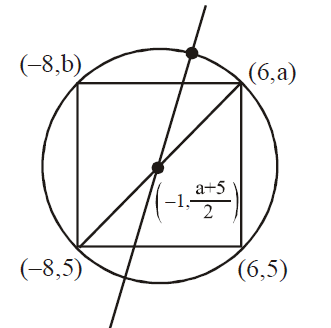
sides = $6$ and $14$
$ \Rightarrow A = 84 $