Q.
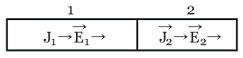
Two cylindrical conductors with equal cross-sections and different resistivities ρ1 and ρ2 are put end to end. Find the charge at the boundary of the conductors if a current I flows from conductor 1 to conductor 2 .
According to ohm's law, E→=ρJ→
The problem is solved by the following steps: Step I: Determine the electric field in both conductors.
The current density in the first conductor is J1=πR2I (Along the length of the conductor)
Similarly,
J2=πR2I (along the length of the conductor)
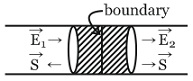
The electric field inside the first conductor is E2=πR2ρ2I (along the length of the conductor) Step II: Consider small cylindrical region near the boundary and apply Gauss's law:
We consider a small cylindrical region at the boundary
The area of the cylindrical region is S=πR2
The net flux through this region is ϕ=ϕ1+ϕ2=E→1.S→+E→2S→ =E1Scos180∘+E2Scos0∘=−E1S+E2S=(E2−E1)S
According to Gauss's Law, ϕ=ε0q
or (E2−E1)=Sε0q=ε0σ ∴ The surface charge density at the boundary is σ=(E2−E1)ε0
Putting the value of E1 and E2, we get ∴σ=(ρ2j−ρ1j) or σ=(ρ2−ρ1)j ∴σ=ε0(ρ2−ρ1)πR2I
or σπR2=ε0(ρ2−ρ1)I
or q=ε0(ρ2−ρ1)I
Charge at the boundary q=ε0(ρ2−ρ1)I