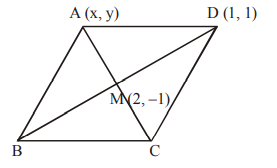
Q.
ABCD is a rhombus. Its diagonals AC and BD intersect at the point M and satisfy BD=2AC. If the coordinates of D and M are (1,1) and (2,−1) respectively, then the coordinates of A are
Let the vertex A be (x,y)
Since the diagonals of a rhombus are perpendicular,
we have, S
Slope of AM× slope of MD=−1 x−2y−1×1−21+1=−1 ⇒x−2y=4…(i)
Given that BD=2AC ⇒MD=2AM
[Since the diagonals of a parallelogram bisect] ∴MD2=4AM2 ⇒(2−1)2+(−1−1)2 =4[(x−2)2+(y+1)2] ⇒4x2+4y2−16x+8y+15=0 ⇒4(2y+4)2+4y2−16(2y+4)+8y+15=0 [ from(i) ] ⇒4y2+8y+3=0 ⇒y=−23 or −21
If y=−23,x=2(−23)+4=1
If y=−21,x=2(−21)+4=3 ∴ A is (1,−23) or (3,−21)