Question Error Report

Thank you for reporting, we will resolve it shortly

Back to Question

Q. $ABCD$ is a rhombus. Its diagonals $AC$ and BD intersect at the point $M$ and satisfy $B D=2 A C$. If the coordinates of $D$ and $M$ are $(1,1)$ and $(2,-1)$ respectively, then the coordinates of $A$ are

Straight Lines

Solution:
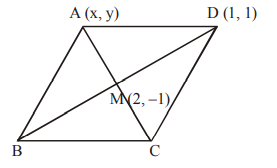
Let the vertex $A$ be $( x , y )$
Since the diagonals of a rhombus are perpendicular,
we have, S
Slope of $AM \times$ slope of $MD =-1$
image
$\frac{y-1}{x-2} \times \frac{1+1}{1-2}=-1 $
$\Rightarrow x-2 y=4 \dots$(i)
Given that $BD =2 AC $
$\Rightarrow MD =2 AM$
[Since the diagonals of a parallelogram bisect]
$\therefore MD ^{2}=4 AM ^{2}$
$\Rightarrow (2-1)^{2}+(-1-1)^{2}$
$=4\left[(x-2)^{2}+(y+1)^{2}\right]$
$\Rightarrow 4 x^{2}+4 y^{2}-16 x+8 y+15=0$
$\Rightarrow 4(2 y+4)^{2}+4 y^{2}-16(2 y+4)+8 y+15=0$
$[$ from(i) $]$
$\Rightarrow 4 y^{2}+8 y+3=0$
$ \Rightarrow y=-\frac{3}{2}$ or $-\frac{1}{2}$
If $y=-\frac{3}{2}, x=2\left(-\frac{3}{2}\right)+4=1$
If $y=-\frac{1}{2}, x=2\left(-\frac{1}{2}\right)+4=3 $
$\therefore $ A is $\left(1,-\frac{3}{2}\right)$ or $\left(3,-\frac{1}{2}\right)$