Question Error Report

Thank you for reporting, we will resolve it shortly

Back to Question

Q. Which of the following statements is/ are true?
(I) Ethers are soluble in conc. $H_{2}SO_{4}$ but separate out on addition of water
(II) Ethers are used as solvents for $BF_{3}$ and Grignard reagent
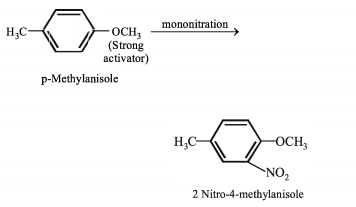
(III) Mononitration of $p$-methylanisole gives $2$-nitro-$4$ methylanisole
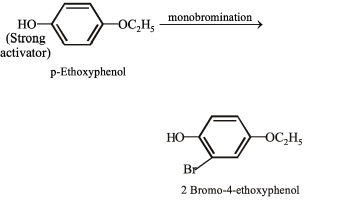
(IV) Monobromination of $p$-ethoxyphenol gives $2$-bromo-$4$-ethoxyphenol
(V) $4$-Chlorophenol (I) will dissolve in $NaOH$ but $4$-chloro-$1$ -methyl benzene (II) will not
(VI) $4$-Methyl benzoic (III) acid will dissolve in aq. $NaHCO_{3}$ but $4$-methyl phenol (IV) will not
(VII) $2,4,6$-Trinitrophenol (V) will dissolve in aq. $NaHCO_{3}$ but $4$-methyl phenol (VI) will not
(VIII) $4$ -Ethyl phenol (VII) will dissolve in aq. $NaOH$ but ethyl phenyl ether (VIII) will not

Alcohols Phenols and Ethers

Solution:
(I) Water is stronger base than ether and removes proton from protonated ether, $R_{2}OH^{+}$
$\underset{\text{Acid}_{1}}{[R_{2}OH]^{+}}$+ $\underset{\text{$Base_{2}$}}{H_{2}O}$ $\to $ $\underset{\text{$Base_{1}$}}{R_{2}O}$+$\underset{\text {$Acid_{2}$}}{H_{3}O^{+}}$
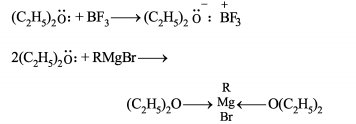
(II) Due to unshared electron pairs, ethers act as Lewis bases and hence easily react with Lewis acids like $BF_{3}$ and $RMgBr$ to form coordinated compounds.
image
Note that two molecules of ether coordinate tetrahedrally with one $Mg^{2+}$
(III) image
(IV) image
(V) Due to -$I$ effect of $Cl$, $4$ -chlorophenol is acidic and dissolves in $NaOH$, but (II) is an aryl halide and does not dissolve
(VI) (III) is an acid and dissolves in $NaHCO_{3}$ but (IV) is a phenol and does not dissolve
(VII) Although (V) is a phenol, because of the presence of $(3NO_{2})$ group, it is exceptionally acidic $(pk_{a}=0.38)$ So it dissolves in $NaHCO_{3}$ but (VI) is a phenol $(pK_{a}=10.17)$ and will not dissolve
(VIII) (VII) is a phenol and dissolves in NaOH, but (VIII) is an ether; and does not dissolve.