Q.
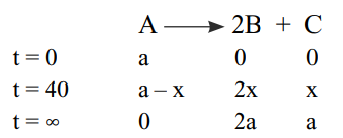
When sucrose is hydrolysed, it produces dextrorotatory "glucose" and laevorotatory "fructose" whereas the reactant itself is a dextrorotatory compound. The above a conversion process follows first order kinetics. Similarly, an optically active compound $A$ is hydrolysed as follows.
$A + H _{2} O \xrightarrow{ H ^{+}} 2 B + C$
The observed rotation of compound $A, B$ and $C$ are $60^{\circ}$, $50^{\circ}$ and $-80^{\circ}$ per mole respectively. The angles of rotation after $40$ minutes and after the completion of reaction were $26^{\circ}$ and $10^{\circ}$ respectively. At $27^{\circ} C$ activation energy for conversion is $27\, kJ\, mol ^{-1}$.
(Use: $\log 1.25=0.0969, \log 14.97=$ 1.175)
The value of rate constant of the above reaction at $27^{\circ} C$ is
Chemical Kinetics
Solution: