Question Error Report

Thank you for reporting, we will resolve it shortly

Back to Question

Q. Account for the following. Write the answers in four or five sentences only.
(i) The experimentally determined $N-F$ bond lengths in $NF_3$ is greater than the sum of the single bond covalent radii of $N$ and $F$.
(ii) $Mg_3N_2$ when reacted with water gives of $NH_3$ but $HCl$ is not obtained from $MgCl_2$ on reaction with water at room temperature.
(iii) $(SiH_3)_3 N $ is a weaker base than $(CH_3 )_3 N.$

IIT JEEIIT JEE 1995The p-Block Elements - Part2

Solution:
(i) The size of both nitrogen and fluorine are very small as well as they have very high electron density. Thus in $NF_3, N$ and $F$ repel each other stretching the $N-F$ bond. Hence, in $NF_3, N-F$ bond lengths are greater than the sum of their single bond covalent radii.
(ii) $Mg_3N_2 + 6 H_2O \longrightarrow 3Mg(OH)_2 + 2NH_3$
$MgCl_2$ is a salt of strong acid $HCl$ and strong base $Mg(OH)_2$ and therefore, not hydrolysed in aqueous solution.
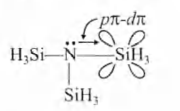
(iii) In $(SiH_3)_3 N$, the lone pair of nitrogen is involved in $p\pi -d\pi$ bonding, less available on nitrogen for donation to a Lewis acid, a weaker Lewis base
image
Carbon does not have any vacant $d$ -orbitals, no such $p\pi-d\pi$ bonding occur in trimethyl amine, lone pair of nitrogen is available for donation to Lewis acid, hence a stronger Lewis base.