Question Error Report

Thank you for reporting, we will resolve it shortly

Back to Question

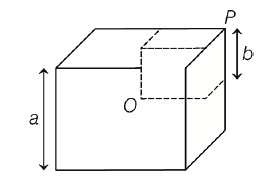
Q. A smaller cube with side $b$ (depicted by dashed lines) is excised from a bigger uniform cube with side a as shown below, such that both cubes have a common vertex $P$. Let $X = a / b$. If the centre of mass of the remaining solid is at the vertex $O$ of smaller cube, then $X$ satisfies image
KVPYKVPY 2016System of Particles and Rotational Motion

Solution:
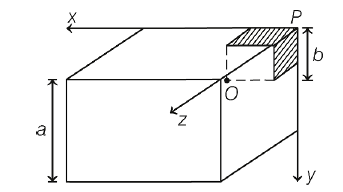
We choose origin at point $P$
image
Now, given centre of mass of remaining solid is at point $O$. Coordinates of $O$ as per axes choosen are $O = (b, b, b)$
i.e. $x = b,y = b$ and $z = b$
Centre of mass of complete large cube lies at its centre.
$\therefore $ Coordinates of centre of mass of large cube are
$x_{1}=\frac{a}{2},y_{1}=\frac{a}{2},Z_{1}=\frac{a}{2}.$
And centre of mass of removed cube of side
$x_{2}=\frac{b}{2},y_{2}=\frac{b}{2},Z_{2}=\frac{b}{2}.$
Treating removed mass as negative mass, we have
$x_{cM}$ (of remaining part) $=\frac{m_{1}x_{1}-m_{2}x_{2}}{m_{1}-m_{2}}$
$\Rightarrow b=\frac{\rho a^{3}\times\frac{a}{2}-\rho b^{3}\times\frac{b}{2}}{\rho a^{3}-\rho b^{3}}$
where, $\rho$ = mass density.
$\Rightarrow a^{3}b-b^{4}=\frac{a^{4}}{2}-\frac{b^{4}}{2} $
$\Rightarrow \frac{a^{3}}{b^{3}}-1=\frac{a^{4}}{2b^{4}}-\frac{1}{2}$
As $X = \frac{a}{b}$, we have
$X^{3}-1=\frac{X^{4}}{2}-\frac{1}{2}$
$\Rightarrow 2X^{3}-1=X^{4}$
$\Rightarrow 2\left(X^{3}-1\right)=X^{4}-1$
$\Rightarrow 2\left(X-1\right)\left(X^{2}+1+X\right)$
$\left(X-1\right)\left(X+1\right)\left(X^{2}+1\right)$
$\Rightarrow X^{3}-X^{2}-X-1=0$