Q.
The coefficient of the quadratic equation ax2+(a+d)x+(a+2d)=0 are consecutive terms of a positively valued, increasing arithmetic sequence. Determine the least integral value of ad such that the equation has real solutions.
ax2+(a+d)x+(a+2d)=0 a,a+d,a+2d are in ↑ A.P. (d>0) (note that positively valued terms ⇒a>0 )
for real roots D≥0 ⇒(a+d)2−4a(a+2d)≥0 ⇒a2+d2+2ad−4a2−8ad≥0
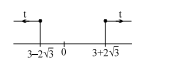
or d2−3a2−6ad≥0 or t2−6t−3≥0 where t=ad and t>0 (d−3a)2−12a2≥0 (d−3a−12a)(d−3a+12a)≥0 [ad−(3+23)][ad−(3−23)]≥0 ∴ d =3+23≥6⇒ least integral value =7