Question Error Report

Thank you for reporting, we will resolve it shortly

Back to Question

Q. The coefficient of the quadratic equation $\operatorname{ax}^2+(a+d) x+(a+2 d)=0$ are consecutive terms of a positively valued, increasing arithmetic sequence. Determine the least integral value of $\frac{ d }{ a }$ such that the equation has real solutions.

Sequences and Series

Solution:
$ax ^2+( a + d ) x +( a +2 d )=0$
$a , a + d , a +2 d$ are in $\uparrow$ A.P. $( d >0) $ (note that positively valued terms $\Rightarrow a >0$ )
for real roots $D \geq 0$
$\Rightarrow (a+d)^2-4 a(a+2 d) \geq 0 $
$\Rightarrow a^2+d^2+2 a d-4 a^2-8 a d \geq 0$
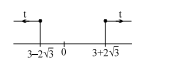
or $d ^2-3 a ^2-6 ad \geq 0 \text { or } t ^2-6 t -3 \geq 0 \text { where } t =\frac{ d }{ a } \text { and } t >0$
$(d-3 a)^2-12 a^2 \geq 0$
$(d-3 a-\sqrt{12} a)(d-3 a+\sqrt{12} a) \geq 0$
image
$\left[\frac{ d }{ a }-(3+2 \sqrt{3})\right]\left[\frac{ d }{ a }-(3-2 \sqrt{3})\right] \geq 0$
$\therefore $ d $=3+2 \sqrt{3} \geq 6 \Rightarrow$ least integral value $=7$