Q.
If f be a function defined on an open interval I. Suppose c∈I be any point. If f has a local maxima or a local minima at x=c, then Statement If′(c)=0. Statement II f is not differentiable at c.
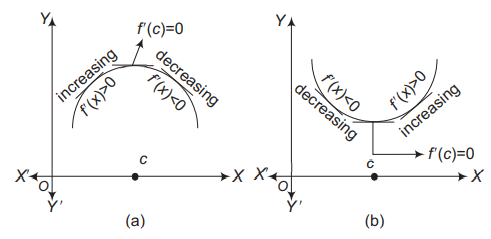
From the previous two solutions, geometrically we can say, if x=c is a point of local maxima of f, then the graph of f around ' c ' will be as shown in Fig (a). Note that function f is increasing (i.e., f′(x)>0) in the interval (c−h,c) and decreasing (i.e., f′(x)<0) in the interval (c,c+h).
This suggests that f′ (c) must be zero.
Similarly, if ' c ' is a point of local minima of f, then the graph of f around ' c ' will be as shown in Fig (b). Here, f is decreasing (i.e., f′(x)<0) in the interval (c−h,c) and increasing (i.e., f′(x)>0) in the interval (c,c+h). This again suggest that f′(c) must be zero.
The above discussion lead us to the following result
Let f be a function defined on an open interval I. Suppose c∈I be any point. If f has a local maxima or a local minima at x=c, then either f′(c)=0 or f is not differentiable at c.