- Tardigrade
- Question
- Biology
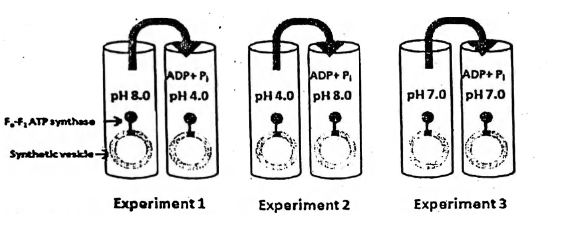
- Experiments 1, 2, and 3 were conducted wherein synthetic vesicles containing F0-F1 ATP synthase were prepared and incubated overnight in a tube. Subsequently, the vesicles were transferred to another tube which also contained ADP and Pi (inorganic phosphate) (A). A proton gradient across the vesicular membrane will be present in both experiments 1 and 2 at the time of transfer. (B). As a consequence of the proton gradient, ATP will be synthesised in both experiments 1 and 2. (C). ATP will be synthesised in experiment 3 because Fo-F1 ATP synthase has the inherent property to catalyse the Synthesis of ATP from ADP and Pi. (D). ATP will be synthesised in experiment 2 because the proton has to flow Out of the vesicles through the F0-F1 ATP synthase for ATP synthesis. <img class=img-fluid question-image alt=image src=https://cdn.tardigrade.in/img/question/biology/ddca59447ddc2f92b35fe298724381e1-.png />
Q.
Experiments and were conducted wherein synthetic vesicles containing synthase were prepared
and incubated overnight in a tube. Subsequently, the vesicles were transferred to another tube which also contained and (inorganic phosphate)
(A). A proton gradient across the vesicular membrane will be present in both experiments 1 and 2 at the time of transfer.
(B). As a consequence of the proton gradient, ATP will be synthesised in both experiments 1 and 2.
(C). ATP will be synthesised in experiment 3 because synthase has the inherent property to catalyse the Synthesis of ATP from ADP and Pi.
(D). ATP will be synthesised in experiment 2 because the proton has to flow Out of the vesicles through the synthase for ATP synthesis.
Solution: