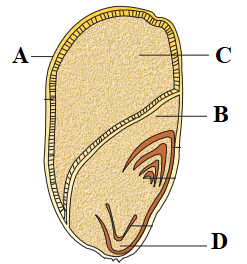
The given figure depicts a monocotyledonous seed. A- Pericarp:
The pericarp is the outermost portion of the seed. It is also known as the seed coat. In the monocot crops, the fruit is known as a caryopsis. In caryopsis type of fruit, the outermost layer, the fruit wall is known as the pericarp. The pericarp is fused with the seed coat. B- Scutellum:
The embryo of monocot seeds consists of many parts, one of which is the cotyledons. The cotyledons, in monocots, are known as "Scutellum". There is one scutellum as monocots have only one cotyledon. The main function of it is to provide nourishment to the developing embryo. C- Endosperm:
The endosperm is the nutrient storage tissue of all seeds. The nutrients are used up by the embryo to develop the scutellum. In dicot seeds, the endosperm is used to develop two cotyledons. The endosperm development in monocots is of helobial type in which cell wall develops between the first two nuclei and later one half develops nuclear type endosperm, while the other half develops cellular type endosperm. D- Coleorhiza:
It is the protective sheath present around the radicle which later forms the root of the plant upon germination. Coleorhiza guards the radicle against any damage and also provides it with nourishment.