Q.
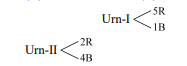
Urn-I contains 5 Red balls and 1 Blue ball,
Urn-II contains 2 Red balls and 4 Blue balls.
A fair die is tossed. If it results in an even number, balls are repeatedly withdrawn one at a time with replacement from urn-I. If it is an odd number, balls are repeatedly withdrawn one at a time with replacement from urn-II. Given that the first two draws both have resulted in a blue ball.
Conditional probability that the first two draws have resulted in blue balls given urn-II is used is
Probability - Part 2
Solution: