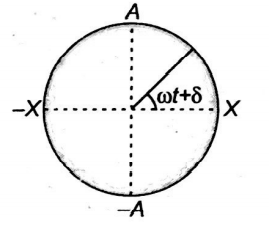
Q. Two simple harmonic motions are given by $ x=A\sin (\omega t+\delta ) $ and $ y=A\sin \left( \omega t+\delta +\frac{\pi }{2} \right) $ act on a particle simultaneously, then the motion of particle will be
Punjab PMETPunjab PMET 2009Oscillations
Solution: