Question Error Report

Thank you for reporting, we will resolve it shortly

Back to Question

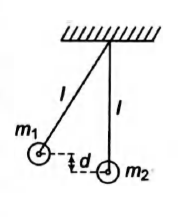
Q. Two pendulums each of length $l$ are initially situated as shown in figure. The first pendulum is released and strikes the second. Assume that the collision is completely inelastic and neglect the mass of the string and any frictional effects. How high does the centre of mass rise after the collision?
image

Work, Energy and Power

Solution:

Applying the law of conservation of momentum
$m_{1} v_{1}=\left(m_{1}+m_{2}\right) V$
where $v_{1}=\sqrt{2gd}$ is the velocity with which $m_{1}$
collides with $m_{2}$
We get: $V=\frac{m_{1}}{\left(m_{1}+m_{2}\right)}\sqrt{2gd}$
Now, let the centre of mass rise through a height $h$ after collision.
In this case, the kinetic energy of $\left(m_1 + m_2\right)$ system is converted into potential energy at maximum height $h.$
$\frac{1}{2}\left(m_{1}+m_{2}\right) V^{2}=\left(m_{1}+m_{2}\right) g h$
$\frac{1}{2}\left(m_{1}+m_{2}\right)\left\{\frac{m_{1}}{m_{1}+m_{2}}\right\}^{2} \cdot 2 g d$
$=\left(m_{1}+m_{2}\right) g h$
$h=d\left\{\frac{m_{1}}{m_{1}+m_{2}}\right\}^{2}$