Question Error Report

Thank you for reporting, we will resolve it shortly

Back to Question

Q. Two cars start out simultaneously from a point in the same direction, one of them going at a speed of $50 \,kmhr^{-1}$ and the other at $40\,kmhr^{-1}$. In half an hour a third car starts out from the same point and overtakes the first car $1.5$ hours after catching up with the second car. The speed of the third car is

Motion in a Straight Line

Solution:
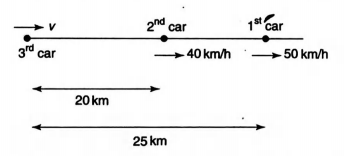
Positions of the cars when third car starts is shown.
image
Let third car catches $2$nd car in time $T$ after it starts out, then
$vT = 40 \,T + 20 \,\,(i)$
Now third car catches $1$st car after time $T + 1.5$, so
$v [T + 1.5] = 50 [T + 1.5] + 25 \,\,(ii)$
Put the value of $T$ from equation $(i)$ into equation $(ii)$,
we get $1.5v^2 - 140v + 3000 = 0$
Put the value of $T$ from equation $(i)$ into equation $(ii)$, we get
$\Rightarrow 2v^2 - 280 v + 6000 = 0$
$\Rightarrow v = \frac{280 \pm \sqrt{(280)^2 - 72000}}{6}$
$\Rightarrow v = \frac{280 \pm 80}{6}$
$ = 60\,km/h, \frac{100}{3} km/h$
Since $v$ can’t be less than $50 \,km/h$, we have
$v = 60 \,km/h$