Thank you for reporting, we will resolve it shortly
Q.
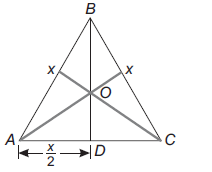
Three identical rods, each of length $ x $ , are joined to form a rigid equilateral triangle. Its radius of gyration about an axis passing through a corner and perpendicular to the triangle is
UPSEEUPSEE 2008System of Particles and Rotational Motion
Solution:
The radius of gyration is the distance from the axis of rotation at which if whole mass of the body is supposed to be concentrated
Here, the whole mass of the equilateral triangle acts at point $O$. So the distance $OA$ is the radius of gyration of this system. Now from triangle $ADB$
$x^{2}+BD^{2}+\left(\frac{x}{2}\right)^{2}$
or $BD^{2}=x^{2}-\frac{x^{2}}{4}$
or $BD^{2}=\frac{3x^{2}}{4}$
or $BD=\sqrt{3}\frac{x}{2}$
Hence, the distance, $OB=\frac{\sqrt{3}x}{2}\times\frac{2}{3}$
$\Rightarrow OB=\frac{x}{\sqrt{3}}$
But the distances $OA$, $OB$ and $OC$ are the same
So, $OA=\frac{x}{\sqrt{3}}$
Hence, the radius of gyration of this system is $\frac{x}{\sqrt{3}}$