Thank you for reporting, we will resolve it shortly
Q.
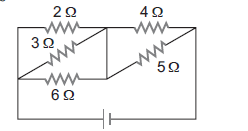
The resistor in which maximum heat will be produced is
Current Electricity
Solution:
Here $2\, \Omega,\, 3\, \Omega$ and $6\, \Omega$ are in parallel.
So, potential drop across them will be the same.
As heat produced, $H=\frac{V^{2}}{R} t$
i.e. $H \propto \frac{1}{R'}$ so maximum heat will be generated across $2\, \Omega$ resistance.
Similarly $4\, \Omega$ and $5\, \Omega$ are also in parallel, so more heat will be generated across $4\, \Omega .$
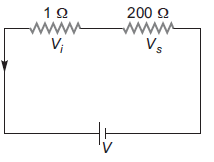
Now the effective circuit will become
Total resistance $=I+\frac{20}{9}=\frac{29}{9} \Omega$
Current $I=\frac{V}{\frac{29}{9}}=\frac{9 V }{29} A$
$V_{1}=\frac{9 V}{29} \times 1=\frac{9}{29} V$
and $ V_{2}=\frac{9 V}{29} \times \frac{20}{9}=\frac{20\, V }{29}$
Power spent across $2\, \Omega$
$P_{1}=\frac{V_{1}^{2}}{2}=\frac{\left(\frac{9 V}{29}\right)^{2}}{2}=\frac{40.5 V^{2}}{(29)^{2}}$
Power spend across $4\, \Omega$
$P_{2}=\frac{V_{2}^{2}}{4}=\frac{\left(\frac{20 V }{29}\right)}{4}=\frac{50\, V ^{2}}{(29)^{2}}$
$\therefore P_{2} > P_{1}$. Hence maximum heat is produced in $4\, \Omega$ resistance.