Thank you for reporting, we will resolve it shortly
Q.
The pairs of consecutive even positive integers, both of which are larger than 5 such that their sum is less than 23, are
Linear Inequalities
Solution:
Let numbers are $2 x$ and $2 x+2$
Then, according to the question,
$2 x>5 \Rightarrow x>\frac{5}{2} $
$ \text { and } 2 x+2>5 \Rightarrow 2 x>5-2 $
$ \Rightarrow 2 x>3 \Rightarrow x>3 / 2 $
$ \text { and } 2 x+2 x+2<23 \Rightarrow 4 x<23-2 $
$\Rightarrow 4 x<21$
$ \Rightarrow x<\frac{21}{4}$
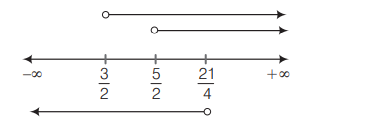
Now, plotting all these values on number line.
From above graph, it is clear that $x \in\left(\frac{5}{2}, \frac{21}{4}\right)$ in which integer values are $x=3,4,5$
When $x=3$, pair is $(2 \times 3,2 \times 3+2)=(6,8)$
When $x=4$, pair is $(2 \times 4,2 \times 4+2)=(8,10)$
When $x=5$, pair is $(2 \times 5,2 \times 5+2)=(10,12)$
$\therefore$ Required pairs are $(6,8),(8,10),(10,12)$.