Question Error Report

Thank you for reporting, we will resolve it shortly

Back to Question

Q. The number of permutations of $n \ldots$ A... objects taken $r$ at a time, where $0 \leq r \leq n$ and the objects do not repeat is ... ... which is denoted by ...C... . Here, A, B and C refer to

Permutations and Combinations

Solution:
$A \rightarrow$ Different
$ B \rightarrow n(n-1)(n-2) \ldots(n-r+1)$
$ C \rightarrow{ }^n P_r$
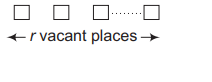
There will be as many permutations as there are ways of filling in $r$ vacant places
image
by the $n$ objects. The first place can be filled in $n$ ways; following which, the second place can be filled in $(n-1)$ ways, following which the third place can be filled in $(n-2)$ ways,..., the $r^{t h}$ place can be filled in $[n-(r-1)]$ ways. Therefore, the number of ways of filling in $r$ vacant places in succession is $n(n-1)(n-2) \ldots .[n-(r-1)] $ or $n(n-1)(n-2) \ldots(n-r+1)$.