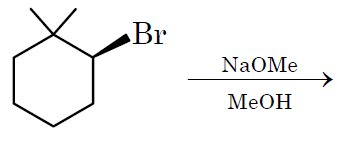
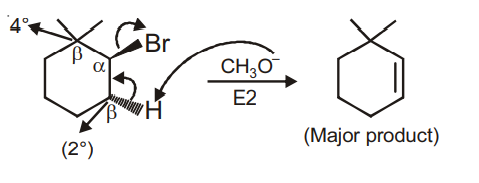
$CH _{3} O ^{-}$ is a strong base and strong nucleophile, so favourable condition is $S _{ N } 2 / E 2$.
Given alkyl halide is $2^{\circ}$ and $\beta C 's$ are $4^{\circ}$ and $2^{\circ}$, so sufficiently hindered, therefore, $E2$ dominates over $S _{ N } 2 .$
Also, polarity of $CH _{3} OH$ (solvent) is not as high as $H _{2} O$, so $E 1$ is also dominated by $E 2$.