Thank you for reporting, we will resolve it shortly
Q.
The area (in sq. units) of the triangle formed by the straight line $x+y=3$ and the angular bisectors of the pair of straight lines $x^{2}-y^{2}+2 y=1$, is
pair of straight line is $x^{2}-y^{2}+2 y=1$
$\Rightarrow x^{2}-\left(y^{2}-2 y+1\right)=0$
$\Rightarrow x^{2}-(y-1)^{2}=0$
$\Rightarrow (x-y+1)(x+y-1)=0$
So, lines are $x+y-1=0$ and $x-y+1=0$
equation of angle bisector is
$\frac{A_{1} x+B_{1} y+c_{1}}{\sqrt{A_{1}^{2}+B_{1}^{2}}}=\pm \frac{A_{2} x+B_{2} y+c_{2}}{\sqrt{A_{2}^{2}+B_{2}^{2}}}$
$\Rightarrow \frac{x+y-1}{\sqrt{2}}=\pm \frac{x-y+1}{\sqrt{2}}$
So, $\frac{x+y-1}{\sqrt{2}}=\frac{x-y+1}{\sqrt{2}}$
and $\frac{x+y-1}{\sqrt{2}}=\frac{-(x-y+1)}{\sqrt{2}}$
$\Rightarrow x+y-1=x-y+1$
and
$x+y-1=-x+y-1$
$\Rightarrow 2 y=2$ and $x=0$
$\Rightarrow y-1=0$
$ \Rightarrow y=1$
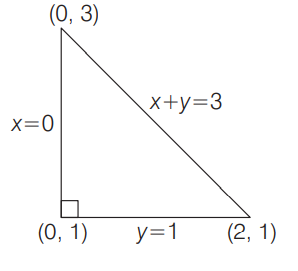
Now, vertices of $\Delta$ formed by $x=0, y=1$ and
$x+y=3$ are $(0,1),(0,3)$ and $(2,1)$
Area of $\Delta=\frac{1}{2}(2)(2)=2$ s q . units.