Question Error Report

Thank you for reporting, we will resolve it shortly

Back to Question

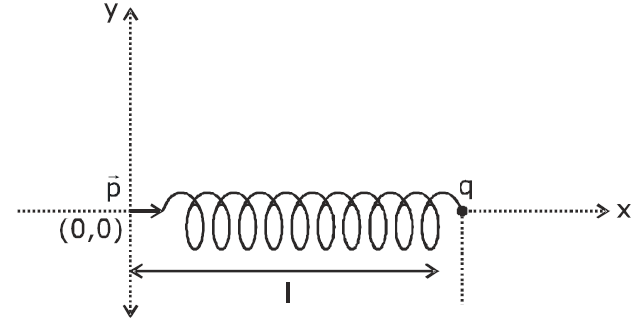
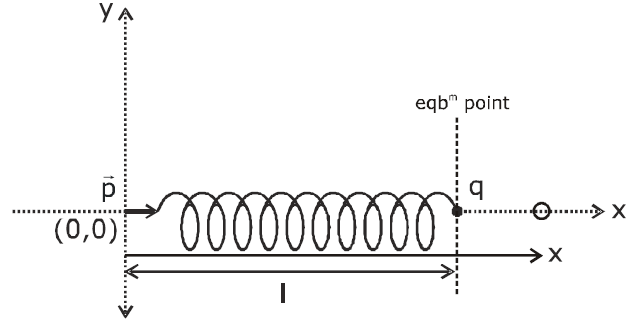
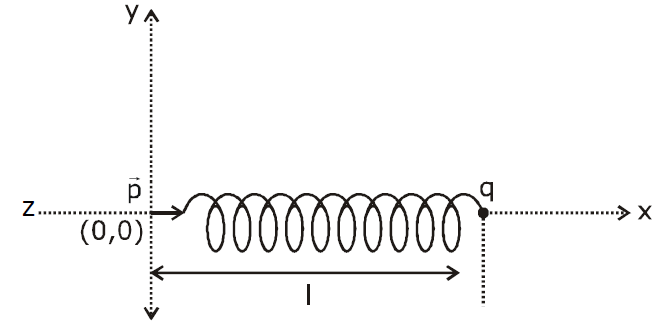
Q. One end of a spring of negligible unstretched length and spring constant $k$ is fixed at the origin $\left(\right.0,0\left.\right)$ A point particle of mass m carrying a positive charge $q$ is attached at its other end. The entire system is kept on a smooth horizontal surface. When a point dipole $\vec{p}$ pointing towards the charge $q$ is fixed at the origin, the spring gets stretched to a length I and attains a new equilibrium position (see figure below). If the point mass is now displaced slightly by $\Delta \left|\right.\ll\left|\right.$ from its equilibrium position and released, it is found to oscillate at frequency $\frac{\delta \pi }{1}\sqrt{\frac{k}{m}}.$ The value of $\delta$ is
Question

NTA AbhyasNTA Abhyas 2022

Solution:

Solution
as we know, for spring block system,
$f=\frac{1}{2 \pi }\sqrt{\frac{K}{m}}$
so we can also observe $k^{'}$ as $\frac{d^{2} U}{d x^{2}}|$ from eq.
$U=\frac{1}{2}kx^{2}$
$\frac{d U}{d x}=Kx$
$\frac{d^{2} U}{d x^{2}}=K$
So we can say,
$f=\frac{1}{2 \pi }\sqrt{\frac{d^{2} U / d x^{2}}{m}}$
so by above concept let us find $P.E.,\left(\right.u\left.\right)$ of system from eqbm. As given, negligible unstretched length, so spring length is elongated length only.
Solution $U=\frac{1}{2} kx ^{2}+\frac{p \times q}{4 \pi \epsilon_{0} x ^{2}} \ldots . .$ (i)
$\frac{d U}{d x}=k x-\frac{2 pq }{4 \pi \in_{0} x ^{3}}$
(for $e q b^{m}, \frac{d U}{d x}=0$ ) given $e q b^{m}$ at $x=\ell$
$\therefore K \ell=\frac{2 pq }{4 \pi \in_{0} \ell^{3}} \ldots$ (2)
diff. eq (1) again, $\frac{d^{2} U}{d x^{2}}=K+\frac{6 pq }{4 \pi \in_{0} x ^{4}}$
as $e q b^m$ at $x=\ell,\left. \therefore \frac{d^2 U}{d x^2}\right|_{\text {at } n=\ell}=K+\frac{6 pq }{4 \pi \in_0 \ell^4}$
(from (2) put value of $\frac{2 pq }{4 \pi \epsilon_{0} \ell^{3}}$ )
$\left.\frac{d^{2} U}{d x^{2}}\right|_{\text {at } x=\ell}= k +3 K =4 K$
$\therefore f=\frac{1}{2 \pi} \sqrt{\frac{d^{2} U / d x^{2}}{m}}=\frac{1}{2 \pi} \sqrt{\frac{4 K }{m}}=\frac{1}{\pi} \sqrt{\frac{k}{m}}$
$\therefore \delta=1$ Ans.