Tardigrade
Tardigrade - CET NEET JEE Exam App
Exams
Login
Signup
Tardigrade
Question
Physics
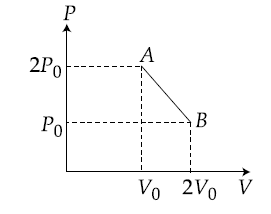
'n' moles of an ideal gas undergoes a process A → B as shown in the figure. The maximum temperature of the gas during the process will be :
Question Error Report
Question is incomplete/wrong
Question not belongs to this Chapter
Answer is wrong
Solution is wrong
Answer & Solution is not matching
Spelling mistake
Image missing
Website not working properly
Other (not listed above)
Error description
Thank you for reporting, we will resolve it shortly
Back to Question
Thank you for reporting, we will resolve it shortly
Q. $'n'$ moles of an ideal gas undergoes a process $A \to B $ as shown in the figure. The maximum temperature of the gas during the process will be :
JEE Main
JEE Main 2016
Thermodynamics
A
$\frac{9\, P_{0}\, V_{0}}{4nR}$
61%
B
$\frac{3\, P_{0} \,V_{0}}{2 nR}$
13%
C
$\frac{9\, P_{0} \,V_{0}}{2 nR}$
16%
D
$\frac{9\, P_{0} \,V_{0}}{nR}$
10%
Solution:
Equation of line $AB$
$y -y_{1} = \frac{y_{2} -y_{1}}{x_{2} -x_{1}}\left(x-x_{1}\right) $
$P - P_{0} = \frac{2P_{0} - P_{0}}{V_{0} - 2V_{0}}$
$\left(V - 2V_{0}\right) = - \frac{P_{0}}{V_{0}} \left(V - 2V_{0}\right) $
$P = - \frac{P_{0}}{V_{0}} V + 3P_{0} $
$PV = - \frac{P_{0}}{V_{0}} V^{2} + 3P_{0}V$
$ nRT = - \frac{P_{0}}{V_{0}}V^{2} + 3P_{0}V $
$T = \frac{1}{nR}\left(\frac{P_{0}}{V_{0} }V^{2} + 3P_{0}V\right)$
$ \frac{dT}{dV} = 0 $ (For maximum temperature)
$ \frac{P_{0}}{V_{0}} 2V + 3P_{0} = 0 $
$\frac{P_{0}}{V_{0}}2V = - 3 P_{0} $
$V = \frac{3}{2}V_{0} $ (Condition for maximum temperature)
$T_{max } = \frac{1}{nR} \left( - \frac{P_{0}}{V_{0} } \times \frac{9}{4} V_{0}^{2}+3P_{0} \times\frac{3}{2}V_{0}\right) $
$= \frac{1}{nR} \left( - \frac{9}{4} P_{0}V_{0} + \frac{9}{2} P_{0}V_{0}0\right) = \frac{9}{4} \frac{P_{0}V_{0}}{nR} $0