Question Error Report

Thank you for reporting, we will resolve it shortly

Back to Question

Q. Let $P_1$ be a regular polygon of $n$ sides with side length $x$ and let $P_{k+1}$ be the regular polygon of $n$ sides formed by joining the mid points of consecutive sides of $P _{ k }$. Also perimeters of the $P _{ i }$ 's form an infinite geometric progression. If $n =6$ and $x =\frac{1}{2+\sqrt{3}}$, then find the sum of this infinite geometric progression.

Sequences and Series

Solution:
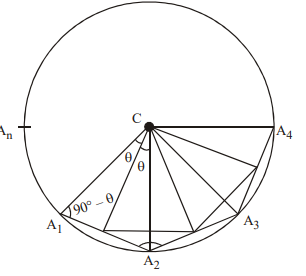
image
The sum of the perimeters, then is
$ S = nx + nx \cos \theta+ nx \cos ^2 \theta+\ldots \ldots \ldots=\frac{ nx }{1-\cos \theta}\left(\text { where } \theta=\frac{\pi}{ n }\right) $
$\text { Put } n =6, \frac{6 x }{1-\cos \frac{\pi}{6}}=\frac{12 x }{2-\sqrt{3}}=12 $
$\text { (where } \left. x \text { is } \frac{1}{2+\sqrt{3}}=2-\sqrt{3}\right) .$
$\cos (\pi-2 \theta)=\frac{\frac{ x ^2}{4}+\frac{ x ^2}{4}- x ^{\prime 2}}{2\left(\frac{ x }{2}\right)\left(\frac{ x }{2}\right)}$
$\frac{- x ^2}{2} \cos 2 \theta=\frac{ x ^2}{2}- x ^{\prime 2} $
$x ^{\prime 2}=\frac{ x ^2}{2}(1+\cos 2 \theta)= x ^2 \cos ^2 \theta $
$\therefore x ^{\prime}= x \cos \theta .$