Question Error Report

Thank you for reporting, we will resolve it shortly

Back to Question

Q. In 3-D space, let three lines $L _1, L _2$ and $L _3$ be such that
$L _1$ : intersecting the $z$-axis at $P (0,0,2)$ and does not meet the $x$-y plane
$L _2$ : passing through the origin and through the point $P$.
$L _3$ : passing through the origin and making positive angles $(\alpha, \beta, \gamma)$ with co-ordinate axes and $45^{\circ}$ angle with line $L _1$
Identify the which of the following statement(s) is(are) correct?

Vector Algebra

Solution:
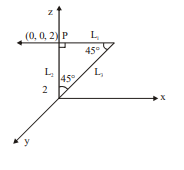
$L _1: \frac{ x }{ a }=\frac{ y }{ b } ; z =2$ (parallel to $xy$-plane)
$L _2: z$-axis
$L _3: \frac{ x }{l}=\frac{ y }{ m }=\frac{ z }{ n }$
$L _3$ is making $45^{\circ}$ with $z$-axis
$\therefore \Delta$ formed by $L _1, L _2, L _3$ is isosceles right angled
$\therefore$ Area of the $\Delta$ is $=\frac{1}{2} \times 2 \times 2=2$ square units
image
Now, $\beta=60^{\circ} \Rightarrow m =\frac{1}{2}, n =\frac{1}{\sqrt{2}} \Rightarrow l=\frac{1}{2}$
$\therefore$ dr's of $L _3$ are $1,1, \sqrt{2}$
Applying, angle between $L _1$ and $L _3$
$\cos 45^{\circ}=\frac{a+b+0}{\sqrt{a^2+b^2} \sqrt{1+1+2}}$
$\frac{1}{\sqrt{2}}=\frac{a+b}{2 \sqrt{a^2+b^2}} \Rightarrow 2\left(a^2+b^2\right)=(a+b)^2 \Rightarrow(a-b)^2=0 \Rightarrow a=b$
$\therefore$ Equation of $L _1$ is : $x = y ; z =2$