Question Error Report

Thank you for reporting, we will resolve it shortly

Back to Question

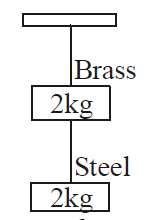
Q. If the ratio of lengths, radii and Young's modulus of steel and brass wires shown in the figure are $a, b $ and $c$ respectively, the ratio between the increase in lengths of brass and steel wires would bePhysics Question Image
VITEEEVITEEE 2009

Solution:

image
Given, $\frac{l_{1}}{l_{2}} =a, \frac{r_{1}}{r_{2}} =b, \frac{Y_{1}}{Y_{2}} =c$
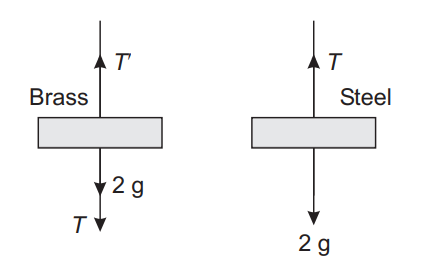
Free body diagram of the two blocks brass and steel are
Let Young's modulus of steel is $Y_1$ and of brass is $Y_2$.
$ \therefore Y_{1} = \frac{F_{1} .l_{1}}{A_{1} .\Delta l_{1}} $ .....(i)
and $ Y_{2} = \frac{F_{2} .l_{2}}{A_{2} .\Delta l_{2}} $ ....(ii)
Dividing Eq. (i) by (ii),
$ \frac{Y_{1}}{Y_{2}} = \frac{\frac{F_{1} .l_{1}}{A_{1} .\Delta l_{1}}}{\frac{F_{2} . l_{2}}{A_{2} .\Delta l_{2}}}$
or $ \frac{Y_{1}}{Y_{2}} = \frac{F_{1} .A_{2} .l_{1} .\Delta l_{2}}{F_{2} .A_{1} .l_{2} .\Delta l_{1}} \,\,\,...(iii)$
Force on steel wire from free body diagram
$ T =F_{1} = \left(2g\right) $ newton
Force on brass wire from free body diagram
$ F_{2} =T' =T + 2g =\left(4g\right) $ newton
Now, putting the value of $F_1, F_2,$ in Eq. (iii), we get
$ \frac{Y_{1}}{Y_{2}} = \left(\frac{2g}{4g}\right). \left(\frac{\pi r_{2}^{2}}{\pi r_{1}^{2}}\right) . \left[\frac{l_{1}}{l_{2}}\right] .\left(\frac{\Delta l_{2}}{\Delta l_{1}}\right) $
or $c = \frac{1}{2} \left(\frac{1}{b^{2}}\right). a\left(\frac{\Delta l_{2}}{\Delta l_{1}}\right) $
or $\frac{\Delta l_{1}}{\Delta l_{2}} = \left(\frac{a}{2b^{2}c}\right) $