Question Error Report

Thank you for reporting, we will resolve it shortly

Back to Question

Q. From a point $P$ on the line $4 x-3 y=6$ two tangents are drawn to the circle $x^{2}+y^{2}-6 x-4 y+4=0 .$ If the angle between these tangents is $\tan ^{-1}\left(\frac{24}{7}\right)$, then $P=$

TS EAMCET 2018

Solution:
Given equation of circle is
$x^{2}+y^{2}-6 x-4 y+4=0$, whose centre is $C(3,2)$ and radius
$=\sqrt{9+4-4}=3$
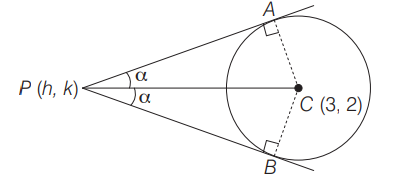
Let $P(h, k)$ be a point on the line $4 x-3 y=6$ from which two tangents are drawn to the circle.
image
Also, let the angle between these tangents is $2 \alpha$, as shown in the figure.
Then, clearly $\angle A P C=\angle B P C=\alpha$ and $\angle P A C=\angle P B C=90^{\circ}$
Now, we have $\quad 2 \alpha=\tan ^{-1} \frac{24}{7}$
$\Rightarrow \tan 2 \alpha=\frac{24}{7}$
$\Rightarrow \frac{2 \tan \alpha}{1-\tan ^{2} \alpha}=\frac{24}{7}$
$\Rightarrow 7 \tan \alpha=12-12 \tan ^{2} \alpha $
$\Rightarrow 12 \tan ^{2} \alpha+7 \tan \alpha-12=0$
$\Rightarrow 12 \tan ^{2} \alpha+16 \tan \alpha-9 \tan \alpha-12=0$
$\Rightarrow 4 \tan \alpha(3 \tan \alpha+4)-3(3 \tan \alpha+4)=0$
$\Rightarrow (4 \tan \alpha-3)(3 \tan \alpha+4)=0$
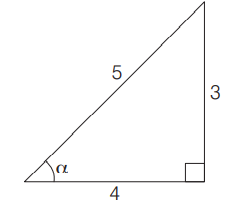
$\Rightarrow \tan \alpha=\frac{3}{4}$
[$\because 3 \tan \alpha+4 \neq 0,$ as $\alpha$ is an acute angle]
image
Also, we have,
$\sin \alpha=\frac{C A}{C P}=\frac{3}{\sqrt{(h-3)^{2}+(k-2)^{2}}}$
$\Rightarrow \frac{3}{5}=\frac{3}{\sqrt{(h-3)^{2}+(k-2)^{2}}}$
$\Rightarrow (h-3)^{2}+(k-2)^{2}=25$
$\Rightarrow h^{2}+9-6 h+k^{2}+4-4 k=25$
$\Rightarrow h^{2}+k^{2}-6 h-4 k=12$
Since, $(h, k)$ lies on $4 x-3 y=6$, therefore $4 h-3 k=6$
$\rightarrow h-\frac{6+3 k}{4}$ ...(ii)
On putting the value of $h$ in Eq. (i), we get
$\left(\frac{6+3 k}{4}\right)^{2}+k^{2}-6\left(\frac{6+3 k}{4}\right)-4 k=12$
$\Rightarrow \frac{36+9 k^{2}+36 k}{16}+k^{2}-\frac{(36+18 k)}{4}-4 k=12$
$\Rightarrow \frac{36+9 k^{2}+36 k+16 k^{2}-144-72 k-64 k}{16}=12$
$\Rightarrow 25 k^{2}-100 k-108=192$
$\Rightarrow 25 k^{2}-100 k-300=0$
$\Rightarrow k^{2}-4 k-12=0$
$\Rightarrow k^{2}-6 k+2 k-12=0$
$\Rightarrow k(k-6)+2(k-6)=0$
$\Rightarrow (k-6)(k+2)=0$
$\Rightarrow k=6$ or $k=-2$
When $k=6,$ then $h=6$
when $k=-2, $ then $h=0$