Question Error Report

Thank you for reporting, we will resolve it shortly

Back to Question

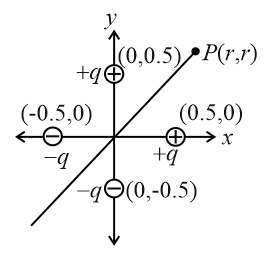
Q. Four charges $+q$ , $+q$ , $-q$ , and $-q$ are placed on $X-Y$ plane at the points whose coordinates are $\left(0 . 5 , 0\right)$ , $\left(0 , 0 . 5\right)$ , $\left(- 0 . 5 , 0\right)$ and $\left(0 , - 0 . 5\right)$ respectively.
Question
The electric field due to these charges at a point $P\left(r , r\right)$ , where $r>>0.5$ , will be

NTA AbhyasNTA Abhyas 2022

Solution:

The four charges can be considered two dipoles of equal magnitude and directed along the +x axis and +y axis.
The magnitude of dipole moment $= q x $
(distance between positive and negative charges on x-axis)
$p=q\times 1=q$
The resultant dipole moment of these two dipoles with be, $p_{\text{r}}=\sqrt{q^{2} + q^{2}}=q\sqrt{2}$
The direction of the resultant dipole moment will be at $45^{\circ} $ from the x-axis
The distance of the point $\left(\right.r,r\left.\right)$ from the dipole is $r\sqrt{2}m$
The resultant electric field is
$E=\frac{1}{4 \pi \varepsilon_{0}} \times \frac{2 p_{r}}{(r \sqrt{2})^{3}}$
$=\frac{1}{4 \pi \epsilon _{0}}\times \frac{2 \times q \sqrt{2}}{2 \sqrt{2} r^{3}}$
$=\frac{1}{4 \pi \epsilon _{0}}\times \frac{q}{r^{3}}$