Question Error Report

Thank you for reporting, we will resolve it shortly

Back to Question

Q. An ellipse inscribed in a semi-circle touches the circular arc at two distinct points and also touches the bounding diameter. Its major axis is parallel to the bounding diameter. When the ellipse has the maximum possible area, its eccentricity is

KVPYKVPY 2014

Solution:
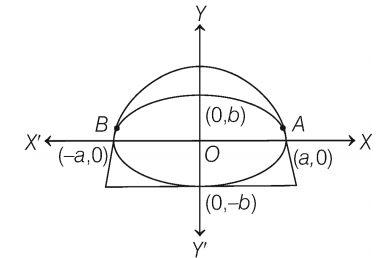
Let equation of ellipse is
image
$\frac{x^2}{a^2} + \frac{y^2}{b^2} = 1$
$\therefore $ Equation of circle is
$x^2 + (y + b)^2 = r^2$
Put $x^2 = a^2 - \frac{a^2y^2}{b^2}$ in circle
$a^{2} - \frac{a^{2}y^{2}}{b^{2}} + \left(y + b\right)^{2} = r^{2} $
$\Rightarrow \left( 1 - \frac{a^{2}}{b^{2}}\right) y^{2} + 2by + \left(a^{2} + b^{2} - r^{2}\right) = 0 $
$ D = 0 $
$ \Rightarrow r^{2} = \frac{a^{4}}{a^{2}-b^{2}} $
$ \Rightarrow b = a \sqrt{1- \frac{a^{2}}{r^{2}}} $
Area of ellipse $= \pi ab $
$ A = \pi a^{2}\sqrt{1- \frac{a^{2}}{r^{2}}}$
$ \frac{dA}{da} = 0 $
$ \Rightarrow a^{2} = \frac{2r^{2}}{3} $
$\Rightarrow a = \sqrt{\frac{2}{3}}r$
$\therefore b = a \sqrt{1 -\frac{2}{3}} = \frac{a}{\sqrt{3}} $
$\Rightarrow e = \sqrt{1- \frac{b^{2}}{a^{2}}} = \sqrt{1- \frac{1}{3}}$
$ =\sqrt{\frac{2}{3}}$