Question Error Report

Thank you for reporting, we will resolve it shortly

Back to Question

Q. An asteroid of mass $m$ is approaching earth, initially at a distance of $10 R_e$ with speed $v_i$. It hits the earth with a speed $v_f\left(R_e\right.$ and $M_e$ are radius and mass of earth), then

NEETNEET 2022

Solution:
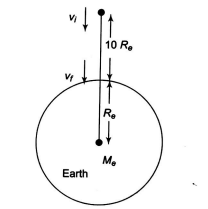
Applying law of conservation of energy for asteroid at a distance $10 R_e$ and at earth's surface,
image
$K_i+U_i=K_f+U_f$ (i)
Now, $K_i=\frac{1}{2} m v_i^2$ and $U_i=\frac{G M_e m}{10 R_e}$
$K_f=\frac{1}{2} m v_f^2 \text { and } U_f=-\frac{G M_e m}{R_e}$
Substituting these values in Eq. (i), we get
$ \frac{1}{2} m v_i^2-\frac{G M_e m}{10 R_e}=\frac{1}{2} m v_f^2-\frac{G M_e m}{R_e} $
$\Rightarrow \frac{1}{2} m v_f^2=\frac{1}{2} m v_i^2+\frac{G M_e m}{R_e}-\frac{G M_e m}{10 R_e} $
$\Rightarrow v_f^2=v_i^2+\frac{2 G M_e}{R_e}-\frac{2 G M_e}{10 R_e} $
$\therefore v_f^2=v_i^2+\frac{2 G M_e}{R_e}\left(1-\frac{1}{10}\right)$