Question Error Report

Thank you for reporting, we will resolve it shortly

Back to Question

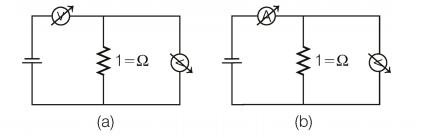
Q. A student uses the resistance of a known resistor $(1\, \Omega)$ to calibrate a voltmeter and an ammeter using the circuits shown below. The student measures the ratio of the voltage to current to be $1 \times 10^3\, \,\Omega$ in circuit (a) and $0.999\, \Omega$ in circuit (b). From these measurements, the resistance (in $\Omega$) of the voltmeter and ammeter are found to be close to
image

KVPYKVPY 2019

Solution:

When a voltmeter put in series, it still reads potential drop and when an ammeter is connected in parallel, it still shows current through it.
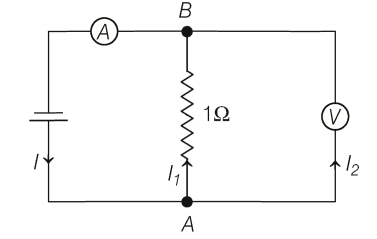
Case a
image
Let $I =$ current through cell, then potential drop read by voltmeter is
$V = I\cdot Rv$ (this is reading of voltmeter)
Where, $R_v$ is the resistance of voltmeter
In loop $AB$,
$V_{AB} = I_1 \times 1 = I_2 \times R_A $ and $I = I_1 + I_2$
Where, $R_A$ is the resistance of ammeter We substitute for $I_1$ from above equation to get
$\Rightarrow I = I_2R_A + I_2 = I_2(R_A + 1)$
$\Rightarrow I_2 = \frac{I}{(R_A + 1)}$
(this is reading of ammeter)
Now given,
$\frac{\text{voltmeter reading}}{\text{ammeter reading}} = 1\times 10^3$
$ =\frac{IR_v}{(\frac{I}{R_A + 1})}$
So, $R_V(R_A + 1) = 1000\,\,\,...(i)$
Case b
image
Let $I =$ current through cell, then ammeter reading in this case is $I$.
Also, in loop $AB$,
$V_{AB} = I_1 \times 1 = I_2 \times R_V$
As $I = I_1 + I_2 = I_2 R_v+I_2$
So, $I_2 = \frac{I}{(R_v + 1})$
Hence, voltmeter reading is $V =I_2R_V$
$=\frac{IR_V}{(R_V + 1)}$ (this is reading of voltmeter)
Now given, voltmeter reading $÷$ ammeter reading $= 0.999\,\Omega$
So, $0.999 = \frac{\left[\frac{IR_{V}}{\left(R_{V}+1\right)}\right]}{I} $
$ \Rightarrow 0.999 = \frac{R_{V}}{R_{V}+1} $
So, $R_{V} = 999\Omega \,\,\,...(ii)$
$\approx 10^3\,\Omega$
Substituting $R_v$ in Eq $(i)$, we get
$R_A = \frac{1}{999}$
or $R_A = 10^{-3} \,\Omega$