Question Error Report

Thank you for reporting, we will resolve it shortly

Back to Question

Q. A solid cylinder of mass ' $M$ ' and radius ' $R$ ' rolls down an inclined plane of length ' $L$ ' and height ' $h$ ' without slipping. Find the speed of its centre of mass when the cylinder reaches its bottom?

AP EAMCETAP EAMCET 2020

Solution:
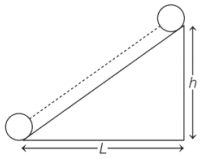
The given situation is shown in the following figure.
image
When cylinder reaches at bottom, then its whole potential energy is converted into its rotational kinetic energy and linear kinetic energy of its centre of mass.
Hence, $M g h=\frac{1}{2} I \omega^{2}+\frac{1}{2} M v_{COM}^{2}$
$=\frac{1}{2} \times \frac{M R^{2}}{2} \times\left(\frac{v_{COM}}{R}\right)^{2}+\frac{1}{2} M v_{COM}^{2}$
$\left[\because I=\frac{M R^{2}}{2}\right.$ and $\left.\omega=\frac{v_{COM}}{R}\right]$
$=\frac{M v_{COM}^{2}}{4}+\frac{M v_{C O M}^{2}}{2}$
$\Rightarrow M gh=\frac{3}{4} M v_{C O M}^{2}$
$\Rightarrow v_{COM}^{2}=\frac{4 g h}{3}$
$\Rightarrow v_{COM}=\sqrt{\frac{4 g h}{3}}$