Question Error Report

Thank you for reporting, we will resolve it shortly

Back to Question

Q. A rigid bar of mass $15\, kg$ is supported symmetrically by three wire each of $2 \,m$ long. These at each end are of copper and middle one is of steel. Young's modulus of elasticity for copper and steel are $110 \times 10^{9} N / m ^{2}$ and $190 \times 10^{9} N / m ^{2}$ respectively. If each wire is to have same tension, ratio of their diameters will be

Mechanical Properties of Solids

Solution:
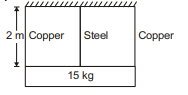
image
Tension is same (given)
From free body diagram
$3 T=150\, N $
Since the bar has to be supported symmetrically
Therefore extension in each wire will be same
We know $\Delta x=\frac{F L}{A Y}$
Compare 1 copper wire with another steel wire
$\frac{F L}{A_{C} Y_{C}}=\frac{F L}{A_{S} Y_{S}} $
$\Rightarrow \frac{A_{S}}{A_{C}}=\frac{Y_{C}}{Y_{S}}$
where
$A_c $- Area of copper wire
$Y_c$ - Young's modulus copper
$A_s$ - Area of steel wire
$Y_s$ - Young's modulus steel
Substituing value of $Y_{c}$ and $Y_{s}$
$\frac{\pi d_{S}^{2}}{4 \times \frac{\pi}{4} \times d_{C}^{2}}=\frac{110 \times 10^{9}}{190 \times 10^{9}}$
$\frac{d_{S}}{d_{C}}=\sqrt{\frac{11}{19}} $
$\{ d_{S}-$ diameter of steel wire
$\{ d_{C}-$ diameter of copper wire
$\frac{d_{C}}{d_{s}}=\sqrt{\frac{19}{11}}$