Question Error Report

Thank you for reporting, we will resolve it shortly

Back to Question

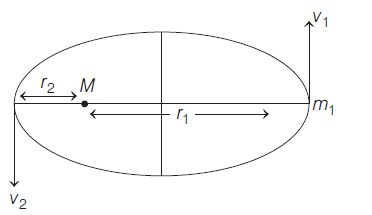
Q. A planet of mass $m$ moves in an elliptical orbit around an unknown star of mass $M$ such that its maximum and minimum distances from the star are equal to $r_1$ and $r_2$ respectively. The angular momentum of the planet relative to the centre of the star is

TS EAMCET 2017

Solution:
image
According to the law of conservation of angular momentum,
$m V_{1} I_{1} =m V_{2} I_{2} $
$\Rightarrow V_{2} =\frac{V_{1} r_{1}}{r_{2}}$ ......(i)
From the law of conservation of total mechanical energy.
$\frac{-G M m}{r_{1}}+\frac{1}{2} m v_{1}^{2}=-\frac{G M m}{r_{2}}+\frac{1}{2} m v_{2}^{2}$ ......(ii)
From Eqs. (i) and (ii), we get
$V_{1}=\sqrt{\frac{2 G M r_{2}}{\left(r_{1}+r_{2}\right) r_{1}}}$
Angular momentum,
$L=m v_{1} r_{1}=m\left(\sqrt{\frac{2 G M r_{2}}{\left(r_{1}+r_{2}\right) r_{1}}}\right) \times r_{1} $
$L=m \sqrt{\frac{2 G M r_{1} I_{2}}{r_{1}+r_{2}}}$