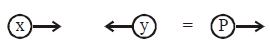
Q. A particle $'P'$ is formed due to a completely inelastic collision of particles $'x'$ and $'y'$ having de-Broglie wavelengths '$\lambda x'$ and '$\lambda y'$ respectively. If $x$ and $y$ were moving in opposite directions, then the de-Broglie wavelength of $'P'$ is :
Solution:
By momentum conservation
$P_x - P_y = P_P$
$\frac{h}{\lambda_{x}} - \frac{h}{\lambda_{y}} = \frac{h}{\lambda_{p}} $
$ \lambda_{p} = \frac{\lambda_{x}\lambda_{y}}{\left|\lambda_{y} -\lambda_{x}\right|} $