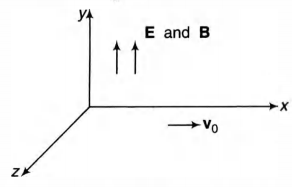
Q. A particle of mass m and charge q is moving in a region where uniform, constant electric and magnetic fields E and B are present. E and B are parallel to each other. At time t = 0, the velocity $v_0$ of the particle is perpendicular to E (Assume that its speed is always<< c, the speed of light in vacuum). Find the velocity v of the particle at time t. You must express your answer in terms of t, q, m, the vector $v_0$ , E and B and their magnitudes $v_0$, E and B.
IIT JEEIIT JEE 1998Moving Charges and Magnetism
Solution:
$ \widehat{j} = \frac{E}{E} \, \, or \, \, \frac{B}{B}: \widehat{i} = \frac{v_0}{v_0}$
$ \, \, \, \, \, \, \, \, \, \widehat{k} = \frac{v_0 \times B_0}{ v_0B}$
Force due to electric field will be along y-axis. Magnetic
force will not affect the motion of charged particle in the
direction of electric field (or y-axis). So,
$ \, \, \, \, \, \, \, a_y = \frac{F_e}{ m} = \frac{ q E}{m} = constant$
Therefore , $ \, \, \, \, \, \, \, \, v_y = a_y t = \frac{ qE}{m} .t $ ............(i)
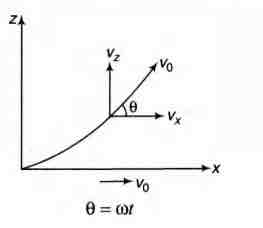
The charged particle under the action of magnetic field
describes a circle in x-z plane (perpendicular to B) with
$ \, \, \, T = \frac{ 2 \pi m}{ B q } \, \, \, \, or \, \, \, \omega = \frac{ 2 \pi }{ T} = \frac{ qB}{m}$
Initially (t = 0) velocity was along x-axis. Therefore,
magnetic force $(F_m)$ will be along positive z-axis
$[Fm = q(v_0 x B )]$. Let it makes an angle 0 with x-axis at time
t, then
$ \, \therefore \, \, \, \, \, \, v_x = v_0 cos \omega t = v_0 cos\bigg( \frac{ qB}{m} t \bigg) $ ..........(ii)
$ \, \, \, \, \, \, \, \, \, \, v_z =v_0 sin \omega t = v_0 sin\bigg( \frac{ qB}{m} t \bigg) $ ..............(iii)
From Eqs. (i), (ii) and (iii),
$ \, \, \, \, \, \, v= v_x \widehat{i} + v_y \widehat{j} +v_z \widehat{k}$
$\therefore \, \, \, \, \, \, \, v= v_0 cos \bigg( \frac{ qB}{m} t \bigg) \bigg( \frac{ v_0}{v_0} \bigg) +\frac{ qB}{m} t \bigg( \frac{ E}{E} \bigg) $
$ \, \, \, \, \, \, \, \, \, \, \, \, \, + v_0 sin \bigg( \frac{ qB}{m} t \bigg) \bigg( \frac{ v_0 \times B}{v_0 B} \bigg)$
$\therefore \, \, \, \, \, \, \, v= cos \bigg( \frac{ qB}{m} t \bigg) (v_0) + \bigg(\frac{ qB}{m} t \bigg)(E) $
$ \, \, \, \, \, \, \, \, \, \, \, \, \, + v_0 sin \bigg( \frac{ qB}{m} t \bigg) \bigg( \frac{ v_0 \times B}{v_0 B} \bigg)$
NOTE The path of the particle will be a helix of increasing pitch
The axis of the helix will be alongy-axis.