Question Error Report

Thank you for reporting, we will resolve it shortly

Back to Question

Q. A particle moves along the curve $y=x^{3 / 2}$ in the first quadrant in such a way that its distance from the origin increases at the rate of 11 units per second. The value of $\frac{d x}{d t}$ when $x=3$ is

Application of Derivatives

Solution:
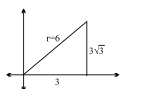
image
$ y=x^{3 / 2} ; \frac{d r}{d t}=11$
$\frac{ dx }{ dt }$ when $x =3$
when $x=3 ; y=3 \sqrt{3}$
$r ^2= x ^2+ y ^2 $
$r \frac{ dr }{ dt }= x \frac{ dx }{ dt }+ y \frac{ dy }{ dt } \ldots \ldots(1) $
$\text { also } \frac{ dy }{ dt }=\frac{3}{2} \sqrt{ x } \frac{ dx }{ dt } \ldots \ldots(2) $
$\therefore r \frac{ dr }{ dt }= x \frac{ dx }{ dt }+ y \frac{3}{2} \sqrt{ x } \frac{ dx }{ dt } $
$ r \frac{ dr }{ dt }=\left( x +\frac{3 y \sqrt{ x }}{2}\right) \frac{ dx }{ dt }$
$ 6 \cdot 11=\left(3+\frac{3 \cdot 3 \sqrt{3} \cdot \sqrt{3}}{2}\right) \frac{ dx }{ dt } \Rightarrow 66=\left(3+\frac{27}{2}\right) \frac{ dx }{ dt } \Rightarrow 66=\left(\frac{33}{2}\right) \frac{ dx }{ dt } $
$\Rightarrow \frac{ dx }{ dt }=4$