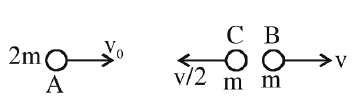
Q. A nucleus A, with a finite de-broglie wavelength $\lambda_A$, undergoes spontaneous fission into to nuclei B and C of equal mass. B flies in the same direction as that of A, while C flies in the opposite direction with a velocity equal to half of that of B. The de-Broglie wavelengths $\lambda_B$ and $\lambda_C$ of B and C are respectively : -
Solution:
let mass of $B$ and $C$ is $m$ each.
By momentum conservation
$2mv_{0} = mv - \frac{mv}{2}$
$ v=4v_{0} $
$p_{A} = 2mv_{0} p_{B} = 4mv_{0} p_{c} = 2mv_{0} $
De-Broglie wavelength $ \lambda= \frac{h}{p}$
$ \lambda_{A} = \frac{h}{2mv_{0}} ; \lambda_{B} = \frac{h}{4mv_{0} } ; \lambda_{C} = \frac{h}{2mv_{0}} $