Question Error Report

Thank you for reporting, we will resolve it shortly

Back to Question

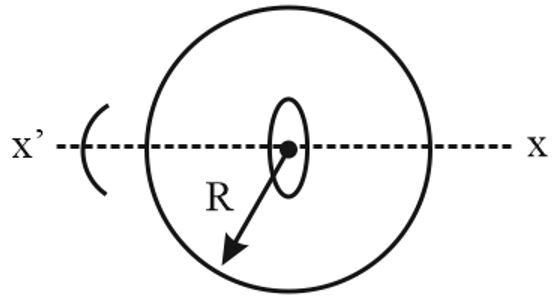
Q. A non-conducting ring of radius $R$ having uniformly distributed charge $Q$ starts rotating about $x-x'$ axis passing through diameter with an angular acceleration $\alpha $ , as shown in the figure. Another small conducting ring having radius $a$ $\left(a \ll R\right)$ is kept fixed at the centre of bigger ring is such a way that axis $xx'$ is passing through its centre and perpendicular to its plane. If the resistance of small ring is $r=1 \, \Omega ,$ find the induced current in it in $ampere$ .

(Given $q=\frac{16 \times 1 0^{2}}{\mu _{0}} \, C,$ $R=1 \, m, \, a \, = \, 0.1 \, m$ , $\alpha =8 \, rad \, s^{- 2}$ )
Question

NTA AbhyasNTA Abhyas 2020

Solution:

Solution
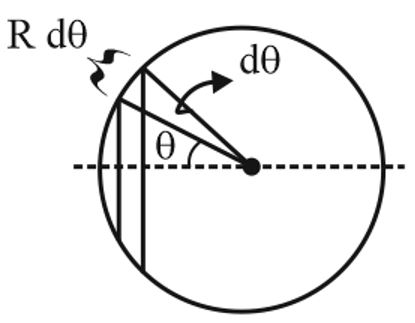
$dq=\frac{q}{2 \pi R}.Rd\theta =\frac{q}{2 \pi }.d\theta $
$di=\frac{d q}{T}=\frac{q d \theta \omega }{2 \pi 2 \pi }$
$di=\frac{q \omega }{4 \pi ^{2}}.d\theta $
The magnetic field at O due to elementary ring is
$d B=\frac{\mu_{0} d i(R \sin \theta)^{2}}{2 R^{3}}$
$\displaystyle \int d B=\displaystyle \int _{0}^{\pi } \frac{\left(\mu \right)_{0} \left(sin\right)^{2} \theta }{2 R} \left(\frac{q \omega }{4 \left(\pi \right)^{2}}\right) d \theta $
$B=\frac{\mu _{0} q \omega }{16 \pi R}$
The flux of the magnetic field through the small ring
$\phi=B\pi a^{2}$
$\phi=\pi a^{2}.\frac{\mu _{0} q \omega }{16 \pi R}$
$\phi=\frac{\mu _{0} q \omega a^{2}}{16 R}$
$\left|\right.\epsilon \left|\right.=\left|\frac{d \phi}{d t}\right|$
$\left|\right.\epsilon \left|\right.=\frac{\mu _{0} q a^{2}}{16 R}\alpha $ .
$=8volt$
$i=\frac{8}{1}=8A$ .