Question Error Report

Thank you for reporting, we will resolve it shortly

Back to Question

Q. A hydrogen atom moving at speed $v$ collides with another hydrogen atom kept at rest. Find the minimum value of $v$ for which one of the atoms may get ionised. The mass of a hydrogen atom $=1.67\times 10^{- 27 \, }kg.$ Assume completely inelastic collision.

NTA AbhyasNTA Abhyas 2020Atoms

Solution:
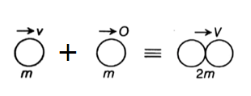
Inelastic collision will take place, if a part of incident kinetic energy is utilised in exciting the atom. Here, one atom is to be ionised, i.e. Assuming completely inelastic collision.
$\Delta E=13.6 eV$
image
For an inelastic collision
$v_{1}=v_{2}=v$
By momentum conservation,
$m v=2 m V$
$\Rightarrow V=\frac{v}{2}$
$\frac{1}{2} m v^{2}=\frac{1}{2} \cdot 2 m V^{2}+\Delta E$
$=m\left(\frac{v}{2}\right)^{2}+\Delta E \quad[\because V=v / 2]$
$\frac{1}{4} m v^{2}=\Delta E$
$v=\sqrt{\frac{4 \Delta E}{m}}$
$v_{\min }=\sqrt{\frac{4 \times 13.6 \times 1.6 \times 10^{-19}}{1.67 \times 10^{-27}}}$
$=7.2 \times 10^{4} m / s$