Q.
A frame of reference that is accelerated with respect to an internal frame of reference is called a non-inertial frame of reference. A coordinate system fixed on a circular disc rotating about a fixed axis with a constant angular velocity $\omega$ is an example of a non-inertial frame of reference.
The relationship between the force $\vec{F}_{\text {rot }}$ experienced by a particle of mass $m$ moving on the rotating disc and the force $\vec{F}_{\text {in }}$ experienced by the particle in an internal frame of reference is
$\vec{ F }_{ rot }=\vec{ F }_{ in }+2 m \left(\vec{ v }_{ rot } \times \vec{\omega}\right)+ m (\vec{\omega} \times \vec{ r }) \times \vec{\omega}$
where $\vec{ v }_{ rot }$ is the velocity of the particle in the rotating frame of reference and $\vec{ r }$ is the position vector of the particle with respect to the centre of the disc.
Now consider a smooth slot along a diameter of a disc of radius $R$ rotating counter-clockwise with a constant angular speed $\omega$ about its vertical axis through its center. We assign a coordinate system with the origin at the centre of the disc, the $x$-axis along the slot, the $y$-axis perpendicular to the slot and the z-axis along the rotation axis $(\vec{\omega}=\omega \hat{k})$. A small block of mass $m$ is gently placed in the slot at $\vec{r}=\left(\frac{R}{2}\right) \hat{i}$ at $t=0$ and is constrained to move only along the slot.
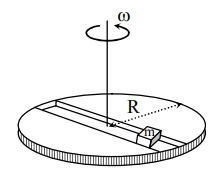
The distance $r$ of the block at time $t$ is
JEE AdvancedJEE Advanced 2016
Solution: