Question Error Report

Thank you for reporting, we will resolve it shortly

Back to Question

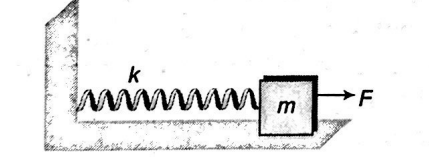
Q. A constant force produces maximum velocity $v$ on the block connected to the spring of force constant $k$ as shown in the figure. When the force constant of spring becomes $4 k$, the maximum velocity of the block is (block is at rest when spring is relaxed):Physics Question Image
Oscillations

Solution:

By work energy theorem;
$F x_{1}-\frac{1}{2} k x_{1}^{2}=\frac{1}{2} m v^{2}\,\,\,...(1)$
and $F x_{2}-\frac{1}{2} k^{\prime} x_{2}^{2}=\frac{1}{2} m v^{\prime 2}\,\,\,....(2)$
where $x_{1}, x_{2}$ are initial and final extensions and $v, v^{\prime}$ are initial and final velocities.
In both cases, force applied is same, and velocity becomes maximum when $F=k x$. (after which the mass will decelerate)
$\therefore F=k x_{1}=(4 k) x_{2}$
$\Rightarrow x_{2}=\frac{x_{1}}{4}$
Substituting in $(2)$:
$F\left(\frac{x_{1}}{4}\right)-\frac{1}{2}(4 K)\left(\frac{x_{1}}{4}\right)^{2}=\frac{1}{2} m v^{2}$
$\Rightarrow \frac{1}{4}\left[F x_{1}-\frac{1}{2} k x_{1}^{2}\right]=\frac{1}{2} m v^{\prime 2} \,\,\,...(3)$
Dividing $(3) /(1)$, we get:
$\frac{1}{4}=\frac{v^{\prime 2}}{v^{2}} $
$\Rightarrow v^{\prime}=\frac{v}{2}$