Question Error Report

Thank you for reporting, we will resolve it shortly

Back to Question

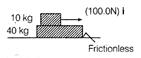
Q. A $40\, kg$ slab rests on a frictionless floor. A $10\, kg$ block rests on top of the slab (as shown in the figure). The coefficient of static friction $\mu_{s}$ between the block and the slab is $0.60$, whereas their kinetic friction coefficient $\mu_{k}$ is $0.40$. The $10 \,kg$ block is pulled by a horizontal force $(100.0\, N) \hat{i}$. The resulting accelerations of the block and slab will be
$\left(\right.$ Take $\left.g=10 \,m / s ^{2}\right)$Physics Question Image
AMUAMU 2013Laws of Motion

Solution:

$f=0.6 \times 10 \times 9.8 \,N=58.8 \,N$
Since the applied force is greater than $f$
therefore the block will be in motion
so, we should consider $f_{k} \cdot f_{k}=0.4 \times 10 \times 9.8 \,N$
or $f_{k}=4 \times 9.8 \,N$
This would cause acceleration of $40\, kg$
block acceleration $=\frac{4 \times 9.8}{40}=(0.98) i \,ms ^{-2}$
$=(1) i \,ms ^{-2}$
Acceleration of $10\, kg$ block
$\frac{58.8}{10}=(5.88) i=(6) i \,m / s ^{2}$