Question Error Report

Thank you for reporting, we will resolve it shortly

Back to Question

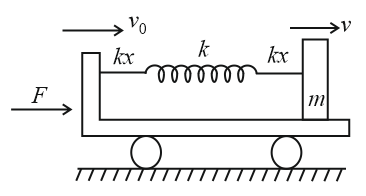
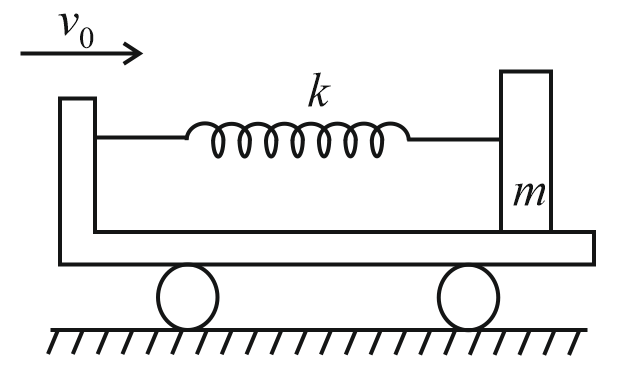
Q. A block of mass $m$ is connected rigidly with a smooth wedge (plank) by a light spring of stiffness $k$. If the wedge is moved with constant velocity $v_{0}$, then find the work done by the external agent until the maximum compression of the spring.
Question

NTA AbhyasNTA Abhyas 2022

Solution:

Let us take wedge $+$ spring $+$ block as a system. The forces responsible for performing work are spring force $k x$ $(\leftarrow)$ and the external force $F(\rightarrow)$.
Solution

Work Energy theorem for block + spring + plank relative to ground:
Applying work-energy theorem, we have $W_{\text {ext }}+W_{ Sp }=\Delta K$
where $W_{ sp }$ the total work done by the spring on wedge and block $-\frac{1}{2} k x^{2}$ and $\Delta K$
= change in KE of the block (because the plank does not change its kinetic
energy)
Then, $ W _{\text {ext }}=\frac{1}{2} k x^{2}+\Delta K$
As the block was initially stationary and it will acquire a velocity $v_{0}$ equal to that of the plank at the time of maximum compression of the spring, the change in kinetic energy of the block relative to ground is
$\Delta K =\frac{1}{2} m v_{0}^{2}$
Substituting $\Delta K$ in the above equation, we have
$W _{\text {ext }}=\frac{1}{2} K x^{2}+\frac{1}{2} m v_{0}^{2}.......$(i)
Work Energy theorem for block $+$ spring $+$ plank relative to the plank $W _{\text {ext }}+ W _{ sp }=$ $\Delta K$ The plank moves with constant velocity, there is no pseudo-force acting on the block. $W_{\text {ext }}=0$ Then the net work done on the system (block + plank), due to the spring, can be given as
$W_{SP} = -\frac{1}{2} kx^2$
As the relative velocity between the observer (plank) and block decreases from $v_{0}$ to zero at the time of maximum compression of the spring, the change in kinetic energy of the block is $\Delta K =-\frac{1}{2} m v_{0}^{2}$.
Substituting $W _{ sp }$ and $\triangle K$ in above equation
$-\frac{1}{2} k x^{2}=-\frac{1}{2} m v_{0}^{2} ....$ (ii)
From (i) & (ii)
$W _{\text {ext }}=\frac{1}{2} m v_{0}^{2}+\frac{1}{2} m v_{0}^{2}=m v_{0}^{2}$